
Image created by ChatGPT
Amazon concluded its fall Prime Big Deal Days yesterday. Amazon also has a Prime Day in the summer. The company generally reports that its Prime Days result in higher sales and that the lower prices Amazon charges during these periods result in substantial savings to consumers. For example, in October 2024, Amazon announced that, “Globally, Prime members saved more than $1 billion across millions of deals, including on seasonal merchandise and gifts.”
Most consumers likely expect that on Prime Days they can buy goods more cheaply on Amazon than on competing sites. That assumption isn’t always accurate, however. For example, Wirecutter is a product-review website owned by the New York Times. Yesterday, it recommended as one of several “best deals from Amazon’s Prime Big Deal Days” Breville’s Smart Oven Air Fryer Pro. Amazon was selling the oven at a price of $320, 20 percent less than its regular price of $400.
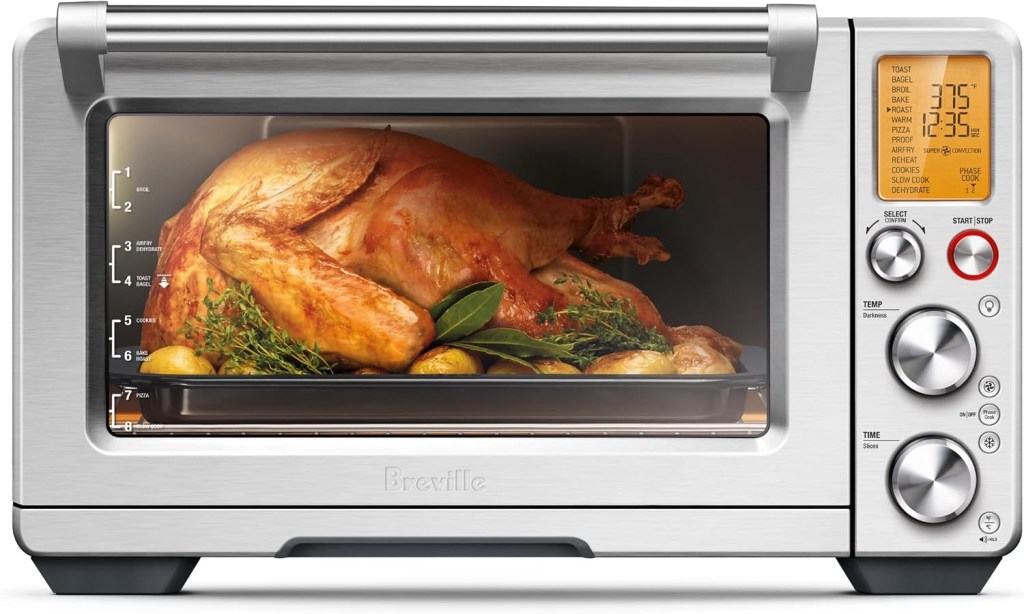
Image from amazon.com
Was that price unusually low? Not in comparison with Amazon’s competitors. Target, Best Buy, and Macy’s were also charging $320 for the same oven. Walmart was charging only $280. This price matching is unsurprising. Amazon’s Prime Days are widely publicized and Amazon’s competitors have an incentive to respond with sales of their own rather than lose business to Amazon. For instance, during Prime Days, Walmart was also advertising that on their site “Deals Are Heating Up in a Major Way.”
The price matching by competitors is, of course, not good news for Amazon. The following figure shows the demand for Breville ovens on amazon.com. For Amazon to experience an increase in the revenue it earns on the ovens from cutting the price by 20 percent, the quantity of ovens it sells would need to increase by more than 20 percent. Suppose that, hypothetically, Amazon would have sold 500 ovens per day at a price of $400 (point A).
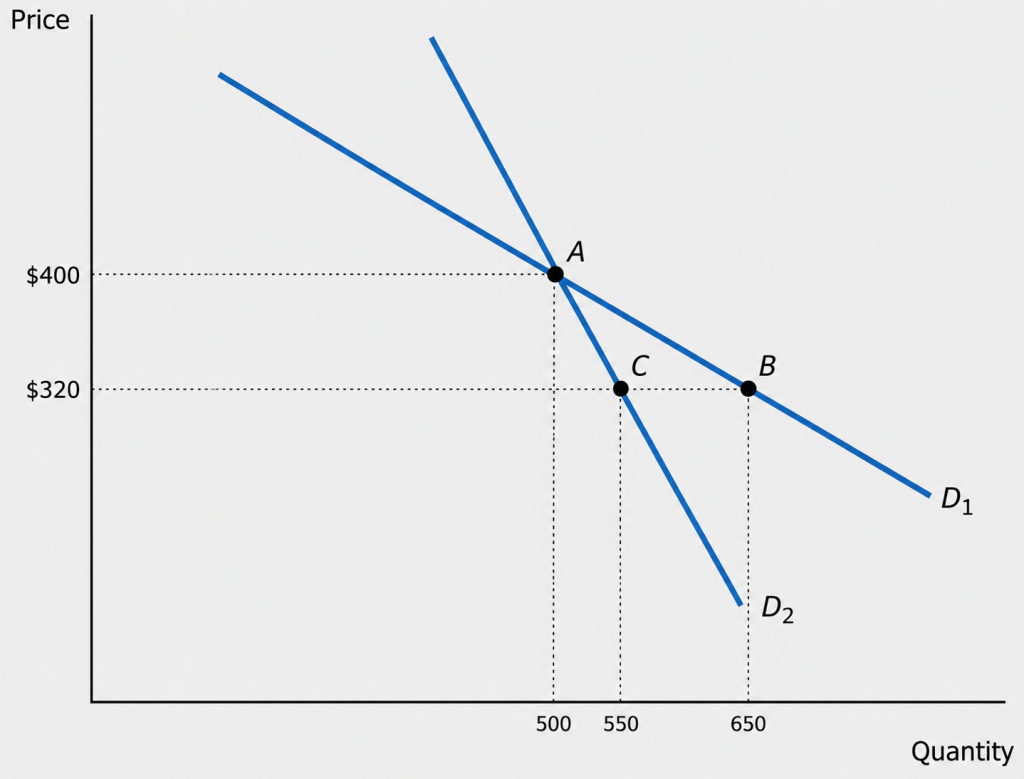
If Amazon cuts the price of the ovens to $320 and its competitors keep their prices at $400, the demand curve for the ovens on amazon.com is D1, so the quantity of ovens Amazon sells increases to 650 per day (point B). In this case, Amazon’s revenue increases from $400 × 500 = $200,000 to $320 × 650 = $208,000. But if Amazon’s competitors match Amazon’s price cut—as we know that they did—then the demand curve for the ovens is D2, so the quantity of ovens Amazon sells increases only to 550 (point C). In this case, Amazon’s revenue decreases from $400 × 500 = $200,000 to $320 × 550 = $176,000.
(In Microeconomics, Chapter 6, we note that when two demand curves intersect, the flatter demand curve, D1—the one with the smaller slope in absolute value—is more price elastic than is the steeper demand curve, D2. In other words, a firm faces a more elastic demand curve when competitors match the firm’s price cuts than when they don’t.)
One way to think about the pricing of these ovens is that with Prime Day price cuts, Amazon pushed itself and its competitors into a prisoner’s dilemma. If we simplify the situation by including just Amazon and Best Buy, we can construct the following payoff matrix. (We discuss payoff matrices and the prisoner’s dilemma in Microeconomics, Chapter 14, Section 14.2.)
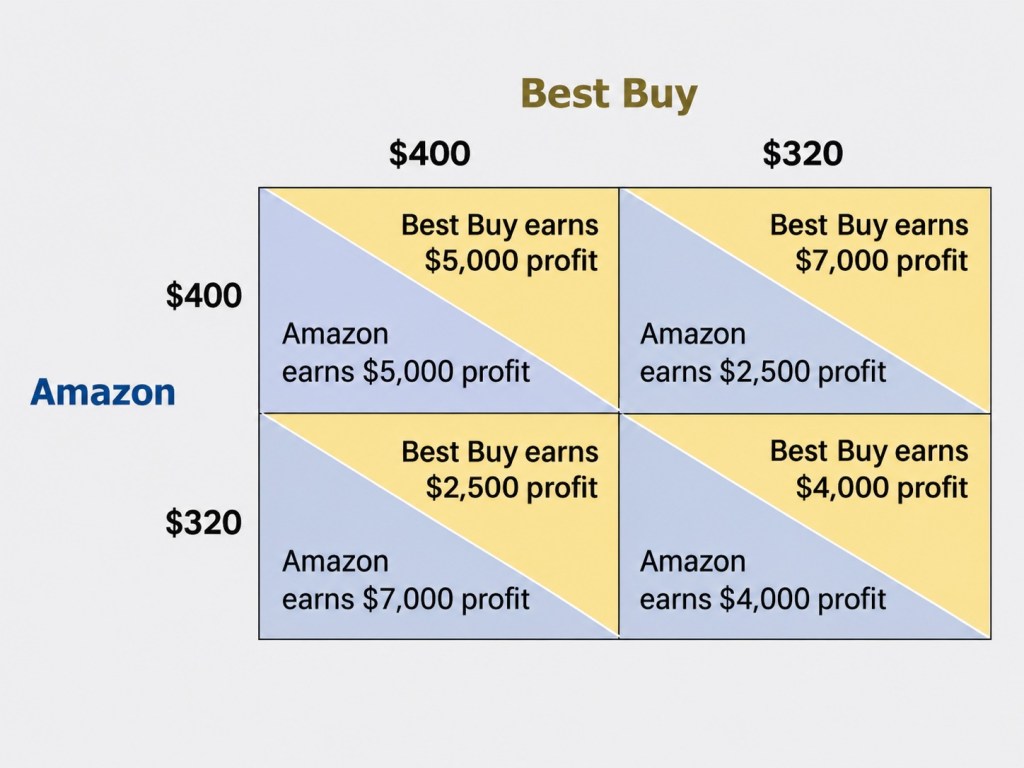
In this payoff matrix, Amazon and Best Buy are better off if they both charge $400 and earn a profit of $5,000 per day from selling the ovens (the upper left-hand quadrant). But if Amazon knows that Best Buy will charge $400, Amazon is better off gaining sales by charging $320 and earning a profit of $7,000 rather than a profit of $5,000 (the lower left-hand quadrant). If Amazon knows that Best Buy will charge $320, Amazon is better off also charging $320 and earning a profit of $4,000 rather than a profit of $2,500 (the lower right-hand quadrant).
Because the payoffs are symmetrical, we can conclude that both firms will charge $320, ending up with the smaller profit shown in the lower right-hand quadrant rather than the larger profit shown in the upper left-hand quadrant. The two firms are in a prisoner’s dilemma.
As we discuss in Chapter 14, in practice, firms can escape the prisoner’s dilemma in situations like this one because the firms are in a repeated game. In that situation, firms are better off cooperating by implicitly colluding and both charging $400. But we wouldn’t expect implicit collision here because during Prime Days, Amazon is publicly announcing that it will charge the lower price. In that case, Amazon’s competitors have an incentive to also charge a lower price, which they did. (Walmart, as we mentioned, decided to charge a price that was even below Amazon’s Prime Day price.)
So, can you get good deals during Amazon’s Prime Days? Yes, not only on their site, but on competitors’ sites as well.

