

Image created by ChatGPT
When did the recession that began at the end of 2007 turn into the Global Financial Crisis? Most economists believe a key turning occurred on Monday, September 15, 2008, when the Lehman Brothers investment bank declared bankruptcy. By the time Lehman failed, the U.S. economy was already in a recession caused by the effects on financial markets of the sharp decline in housing prices. Many financial firms had invested in mortgage-backed securities, which are bundles of mortgage loans that function like a bond. Just as an investor can buy a bond issued by Amazon, an investor can buy a mortgage-backed security issued by a government agency of a financial firm.
The decline in housing prices, increased the number of people who defaulted on their mortgages. Rising mortgage defaults sharply reduced the value of mortgage-back securities, causing some financial firms that had invested in these securities to become insolvent. When Lehman declared bankruptcy and defaulted on its debts, other firms found it difficult to borrow money. The resulting credit crunch, led to falling production and employment.

Image generated by ChatGPT
(Some of the following is a modified version of the discussion in Money, Banking, and the Financial System, Chapter 12. The new fifth edition of the text is now available.) The effect of Lehman’s failure can be seen in movements in an index of financial stress compiled by the Federal Reserve Bank of St. Louis. The index is an average of 18 financial variables, including spreads between interest rates on corporate bonds and Treasury securities, that tend to increase during periods when investors engage in a flight to safety and households and firms face difficulty securing credit. The following figure shows movements in the index from immediately before to immediately after the recession of 2007–2009. The average value of the index is zero, with periods of greater-than-normal financial stress having positive values and periods of lower-than-normal financial stress having negative values.
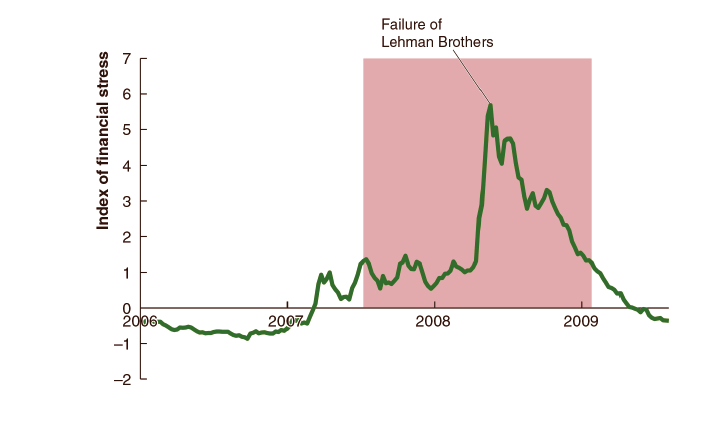
The figure shows that following the failure of Lehman, financial stress jumped dramatically. As households and firms had difficulty obtaining credit and as uncertainty about the economy markedly increased, spending declined sharply. The spending declines resulted in a contraction in production and employment. From the beginning of the recession in December 2007 to the failure of Lehman, total employment in the United States declined by 1.6 million. From the failure of Lehman through the end of 2009, employment declined by an additional 7 million. This employment decline was by far the largest in such a brief period in U.S. history to that time. (Although during the Covid pandemic employment declined by 20 million in April 2020, it began increasing the following month.)
Policymakers and economists have offered two main explanations for why the Fed did not take steps that might have kept Lehman out of bankruptcy:
1. Criticism by members of Congress over the actions the Fed had taken in March 2008 to save the Bear Stearns investment bank coupled with fear of increasing moral hazard in the financial system led the Fed to allow Lehman to declare bankruptcy.
2. Provisions of the Federal Reserve Act tied the Fed’s hands and made it impossible for the Fed to legally save Lehman.
If correct, explanation 1 means that the Fed could have saved Lehman but chose not to, while explanation 2 means that, legally, the Fed could not have saved Lehman even if it had wanted to do so.
Ben Bernanke served as Fed chair during the financial crisis. In his memoirs, published in 2015, Bernanke argued that because Lehman was insolvent, the Federal Reserve Act barred the Fed from saving it:
“It became evident that Lehman was deeply insolvent. . . . Lehman’s insolvency
made it impossible to save with Fed lending alone. . . . We were required [by the
Federal Reserve Act] to lend against adequate collateral. The Fed had no authority to inject capital or (what is more or less the same thing) make a loan that we were not reasonably sure could be fully repaid.”
But was Lehman Brothers actually insolvent? After Lehman’s bankruptcy, some of its creditors were paid back less than what the firm owed them, which seems to indicate that the value of the firm’s assets was less than the value of its liabilities—the definition of insolvency. But economist Laurence Ball of Johns Hopkins University has disputed Bernanke’s account. Ball argues that there is no evidence that Fed policymakers were concerned about Lehman’s solvency at the time they were considering whether to make loans to the bank. Ball believes that Lehman did have sufficient collateral to secure a loan that would have met its short-run liquidity needs. He also notes that the Federal Reserve Act, as it was in 2008 (before it was subsequently amended by the Dodd–Frank Act in 2010), did not keep the Fed from making loans to insolvent firms, provided that the loan being made was secured by adequate collateral. In other words, the fact that Lehman proved to be insolvent once it declared bankruptcy did not necessarily preclude the Fed from making loans large enough to have kept the bank from failing.

Image of then Fed Chair Ben Bernanke and then Secretary of the Treasury Henry Paulson generated by ChatGPT.
Ball argues that explanation 1 above is the reason that the Fed allowed Lehman to fail. In particular, he believes that Treasury Secretary Henry Paulson was heavily involved in the decision and that he was sensitive to the political criticism he had received following the actions the Treasury and Fed had taken to save Bear Stearns the previous spring.
In a recent book, Tyler Goodspeed, chief economist of ExxonMobile and chair of the Council of Economic Advisers during the first Trump administration, has discussed a sometimes overlooked aspect of Lehman’s failure. Goodspeed notes that as Lehman neared bankruptcy, Barclays, a British bank, indicated that it was interested in buying Lehman. According to Goodspeed on Sunday September 14:
“Keen to ensure that Lehman could open for business Monday morning, the U.S. Treasury and Federal Reserve insisted that any buyer guarantees Lehman’s trades. But [United Kingdom] securities regulations required that unless the UK Financial Services Authority (FSA) issued a waiver, such a guarantee would require a vote of Barclays shareholders.”
Given that Lehman was prepared to declare bankruptcy the next day, there wasn’t sufficient time to conduct a vote of Barclays shareholders. The head of the FSA told U.S. financial regulators that he was unwilling to grant a waiver that would have allowed Barclays purchase of Lehman to go through. Treasury Secretary Paulson appealed directly to U.K. Chancellor of the Exchequer Alistair Darling to approve the needed waiver. (The chancellor of the exchequer is the equivalent in the U.K. government of the U.S. secretary of the treasury.) Darling was unwilling to do so however, because he feared that buying Lehman might weaken Barclays financial condition, potentially calling the bank’s solvency into question.

Image created by ChatGPT of the headquarters of the U.K. Treasury
In his memoir, Bernanke gives a similar account:
“{Treasury Secretary] Hank [Paulson] reported that he appealed to his British counterpart, Alistair Darling, chancellor of the exchequer, for a waiver of the shareholder approval requirement. Darling refused to cooperate on the grounds that suspending the rule would be ‘overriding the rights of millions of shareholders.'”
The failure of the British financial regulators to allow Barclays to purchase Lehman made it inevitable that Lehman would declare bankruptcy the following morning. Lehman’s failure led to turmoil in both the U.S. and U.K. financial systems, helping to transform the recession that had already begun in the United States the pervious December into the Global Financial Crisis.
However, the role played by British regulators in Lehman’s bankruptcy is not entirely clear-cut. An article in the Financial Times published late on the afternoon of Sunday, September 14, discussed the attempts to save Lehman from bankruptcy. The article indicates that executives at Barclays saw U.S. financial regulators, not U.K. financial regulators, as responsible for stopping their purchase of Barclays.
According to the article, U.S. regulators were unwilling to guarantee Lehman’s transactions for a period long enough for Barclays to complete the purchase. Barclays would have had to guarantee Lehman’s transactions without funding from U.S. regulators. According to a statement issued by Barclays,“The proposed transaction required a guarantee for the trading operations of Lehman Brothers that was potentially open-ended, and we were not willing to provide that guarantee.”
After nearly 100 years, economists still debate whether the Fed could have acted to avoid the panic panics of the 1930s that significantly worsened the Great Depression. The debate over the failure of Lehman Brothers in 2008 is likely to also continue for years to come.

