
Image generated by Chat-GTP-4o
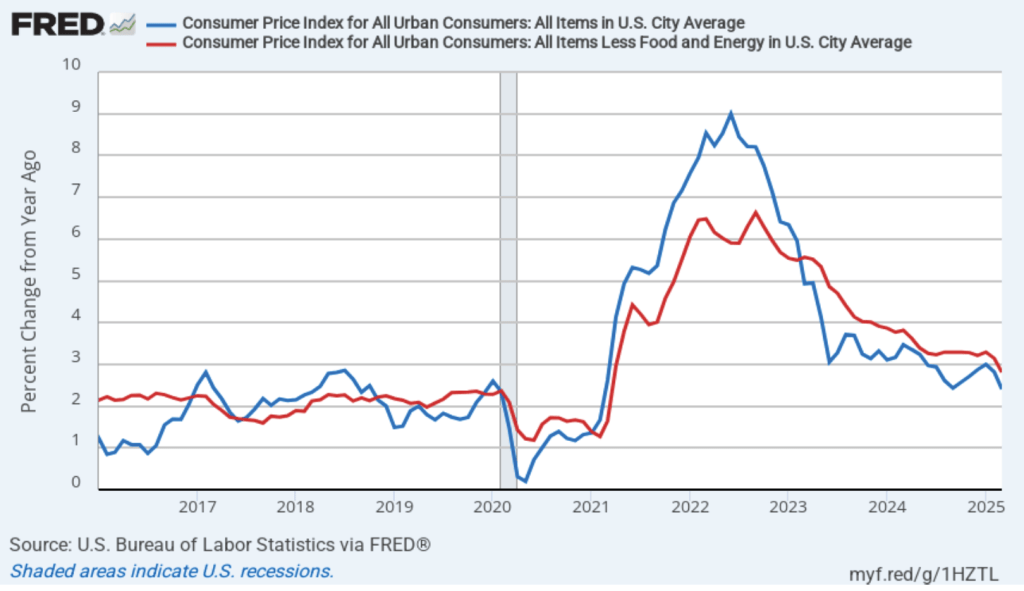
Today (April 10), the Bureau of Labor Statistics (BLS) released its monthly report on the consumer price index (CPI). The following figure compares headline inflation (the blue line) and core inflation (the red line).
- The headline inflation rate, which is measured by the percentage change in the CPI from the same month in the previous year, was 2.4 percent in March—down from 2.8 percent in February.
- The core inflation rate, which excludes the prices of food and energy, was 2.8 percent in March—down from 3.1 percent in February.
Both headline inflation and core inflation were below what economists surveyed had expected.
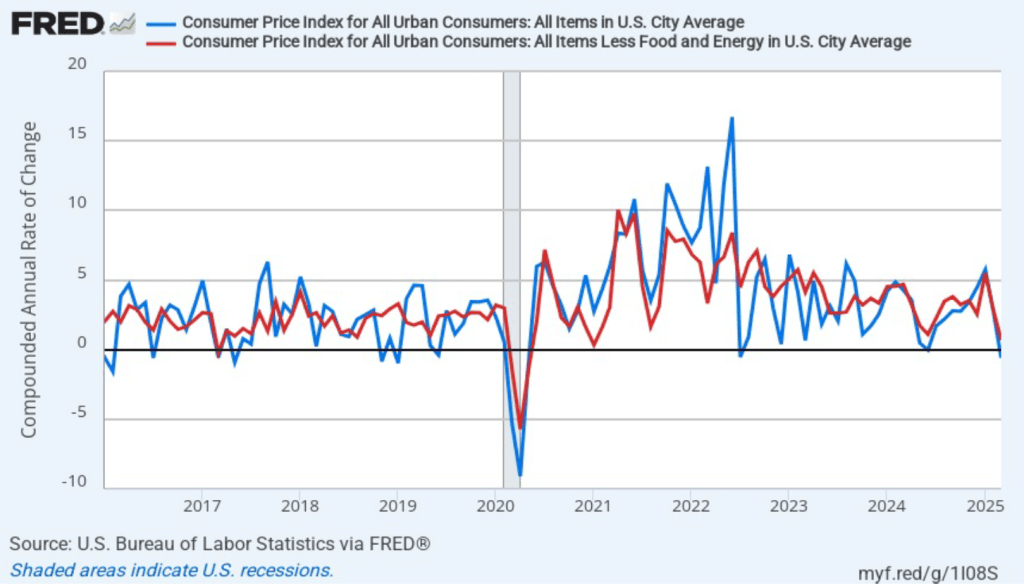
In the following figure, we look at the 1-month inflation rate for headline and core inflation—that is the annual inflation rate calculated by compounding the current month’s rate over an entire year. Calculated as the 1-month inflation rate, headline inflation (the blue line) fell sharply from 2.6 percent in March to –0.6 percent—that is, the economy experienced deflation in March. Core inflation (the red line) decreased from 2.6 percent in February to 0.7 percent in March.
Overall, considering 1-month and 12-month inflation together, inflation slowed significantly in March. Of course, it’s important not to overinterpret the data from a single month. The figure shows that 1-month inflation rate is particularly volatile. Also note that the Fed uses the personal consumption expenditures (PCE) price index, rather than the CPI, to evaluate whether it is hitting its 2 percent annual inflation target.
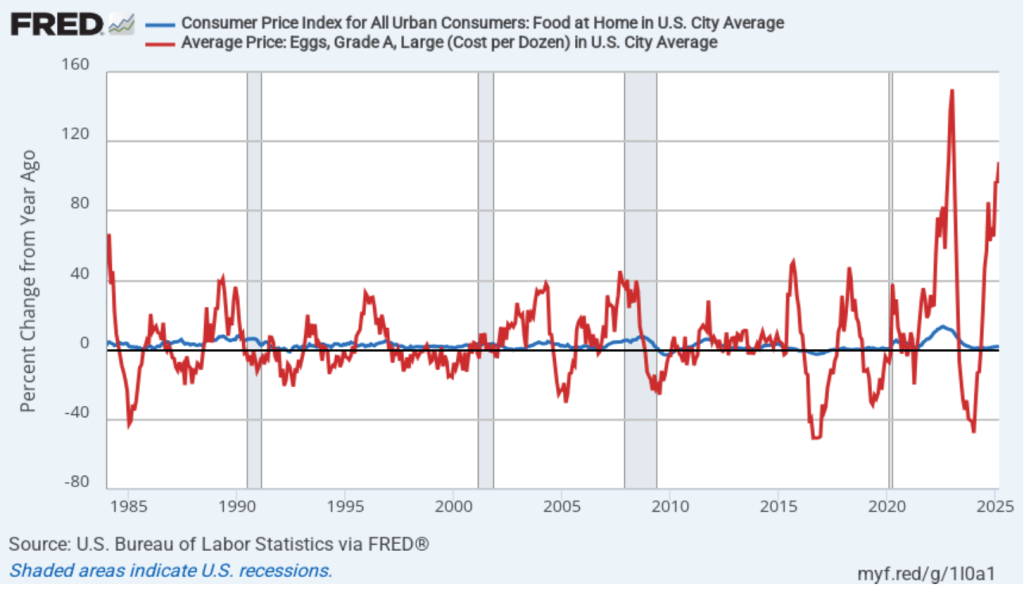
There’s been considerable discussion in the media about continuing inflation in grocery prices. In the following figure the blue line shows inflation in the CPI category “food at home,” which is primarily grocery prices. Inflation in grocery prices was 2.4 percent in March, up from 1.8 percent in February, but still far below the peak of 13.6 percen in August 2022. Although, on average, grocery price inflation has been low over the past 18 months, there have been substantial increases in the prices of some food items. For instance, egg prices—shown by the red line—increased by 108.1 percent in March. But, as the figure shows, egg prices are usually quite volatile month-to-month, even when the country is not dealing with an epidemic of bird flu.
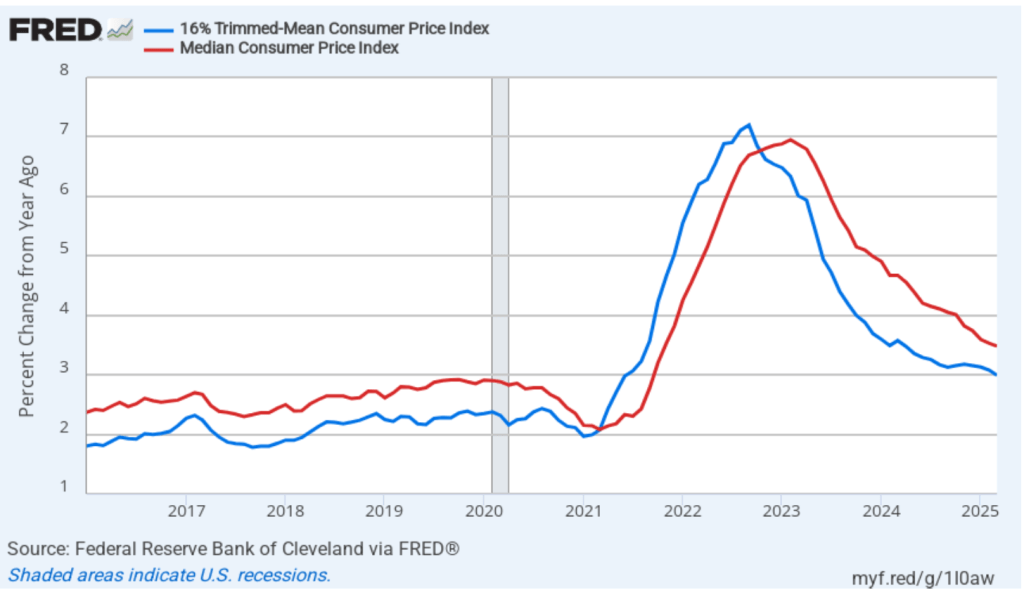
To better estimate the underlying trend in inflation, some economists look at median inflation and trimmed mean inflation.
- Median inflation is calculated by economists at the Federal Reserve Bank of Cleveland and Ohio State University. If we listed the inflation rate in each individual good or service in the CPI, median inflation is the inflation rate of the good or service that is in the middle of the list—that is, the inflation rate in the price of the good or service that has an equal number of higher and lower inflation rates.
- Trimmed-mean inflation drops the 8 percent of goods and services with the highest inflation rates and the 8 percent of goods and services with the lowest inflation rates.
The following figure shows that 12-month trimmed-mean inflation (the blue line) was 3.0 percent in March, down from 3.1 percent in February. Twelve-month median inflation (the red line) also declined slightly from 3.1 percent in February to 3.0 percent in March.
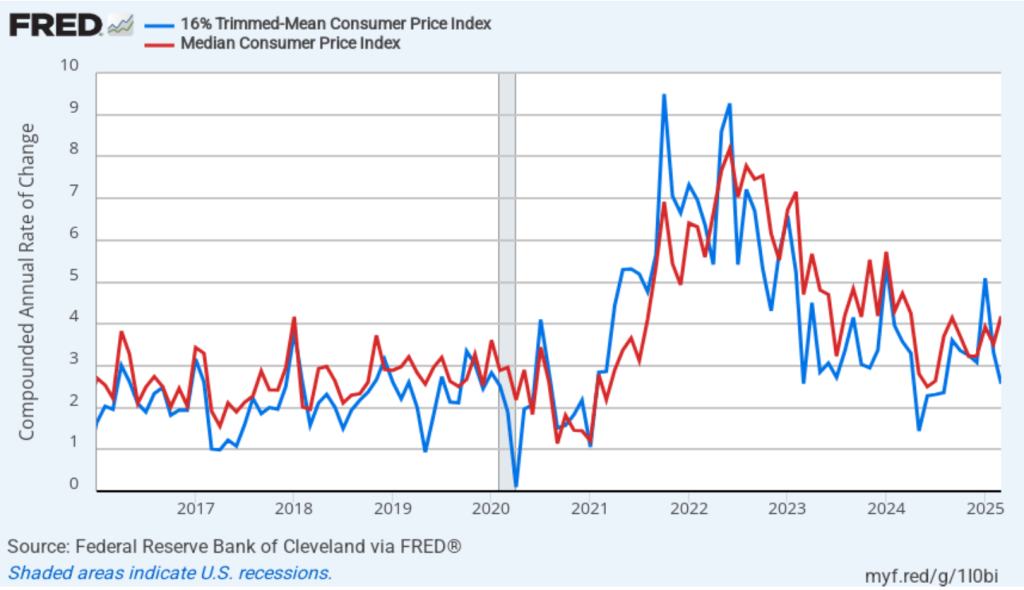
The following figure shows 1-month trimmed-mean and median inflation. One-month trimmed-mean inflation fell from 3.3 percent in February to 2.6. percent in March. One-month median inflation increased from 3.5 percent in February to 4.1 percent in March. These data are noticeably higher than either the 12-month measures for these variables or the 1-month and 12-month measures of headline and core inflation. Again, though, all 1-month inflation measures can be volatile.
There isn’t much sign in today’s CPI report that the tariffs recently imposed by the Trump Administration have affected retail prices. President Trump announced yesterday that many of the tariffs would be suspended for at least 90 days, although the across-the-board tariff of 10 percent remains in place and a tariff of 145 percent has been imposed on goods imported from China. It would surprising if those tariff increases don’t begin to have at least some effect on the CPI over the next few months. As we noted in this post from earlier in the month, Tariffs pose a dilemma for the Fed, because tariffs have the effect of both increasing the price level and reducing real GDP and employment.
What are the implications of this CPI report for the actions the Federal Reserve’s policymaking Federal Open Market Committee (FOMC) may take at its next two meetings? Investors who buy and sell federal funds futures contracts still do not expect that the FOMC will cut its target for the federal funds rate at its next two meetings. (We discuss the futures market for federal funds in this blog post.) Today, investors assigned only a 29.9 percent probability that the Fed’s policymaking Federal Open Market Committee (FOMC) will cut its target from the current 4.25 percent to 4.50 percent range at its meeting on May 6–7. Investors assigned a probability of 85.2 percent that the FOMC would cut its target after its meeting on June 17–18 by at least 0.25 percent (or 25 basis points).
By the time the FOMC meets again in early May we may have more data on the effects the tariffs are having on the economy.
 HubbardOBrienEconomics.com Blog