Image created by ChatGPT
The United States and Canada have a long history of friendly relations and, famously, share the longest undefended border in the world. Trade in goods and services has also linked the two countries with substantial economic benefits to both. By and large, trade flows reflect each country’s comparative advantage in producing goods and services. (We discuss the important role of comparative advantage in international trade in Microeconomics, Chapter 9 (Economics, Chapter 9 and Macroeconomics, Chapter 7).)
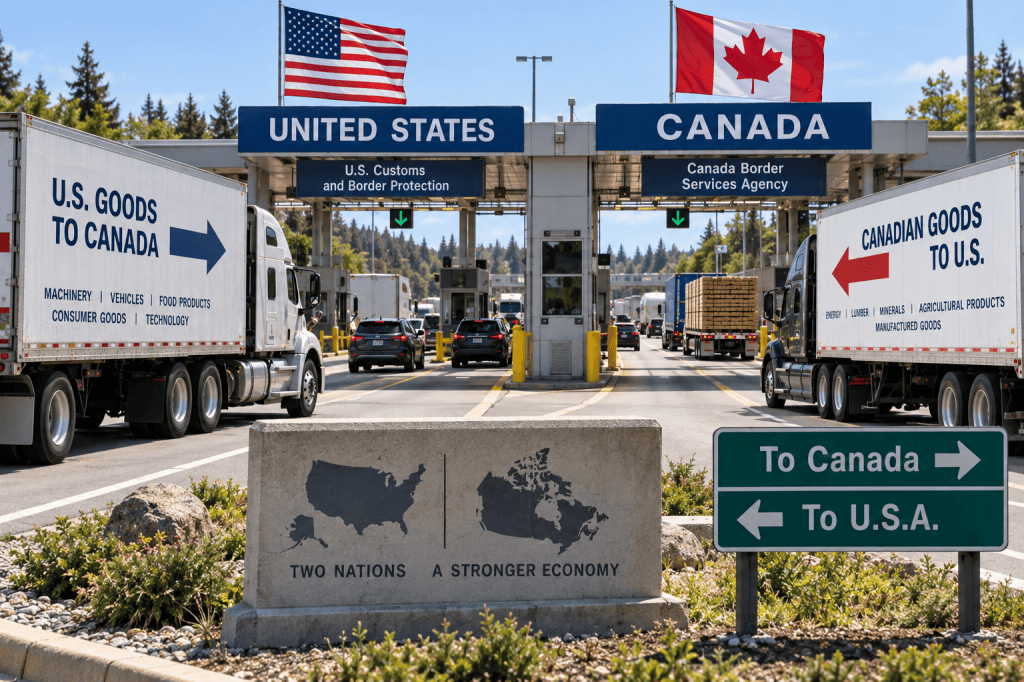
Image created by ChatGPT
The following figures show that in 2025, Canada was the leading market for U.S. exports and the second leading source of U.S. imports, behind only Mexico.
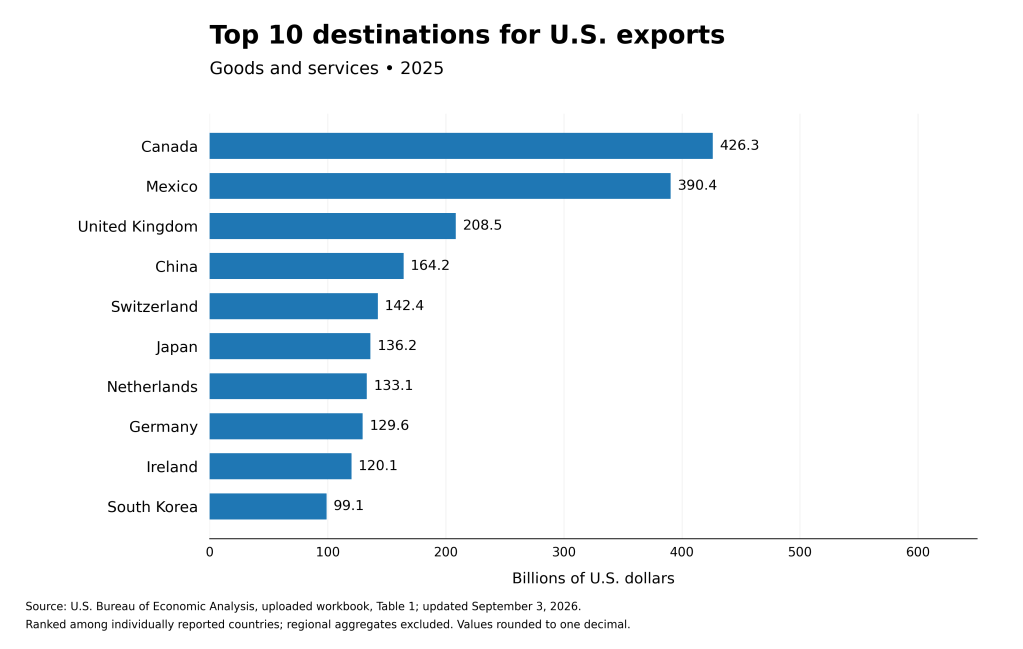
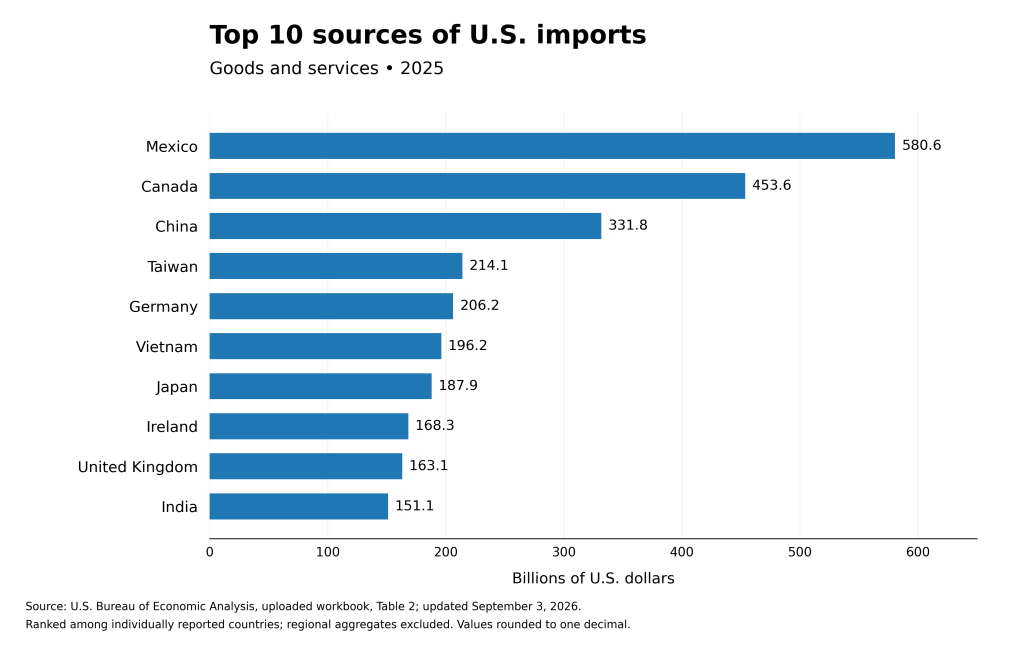
The two figures were prepared by ChatGPT using data from the U.S. Bureau of Economic Analysis.
Beyond trade in final goods and services, a number of U.S. and Canadian firms rely on capital goods and intermediate goods produced in the other country. For instance, in 2025, U.S. automobile manufacturers imported auto parts worth $19.5 billion from Canada. In other words, the supply chains of these firms rely on Canadian-produced parts.
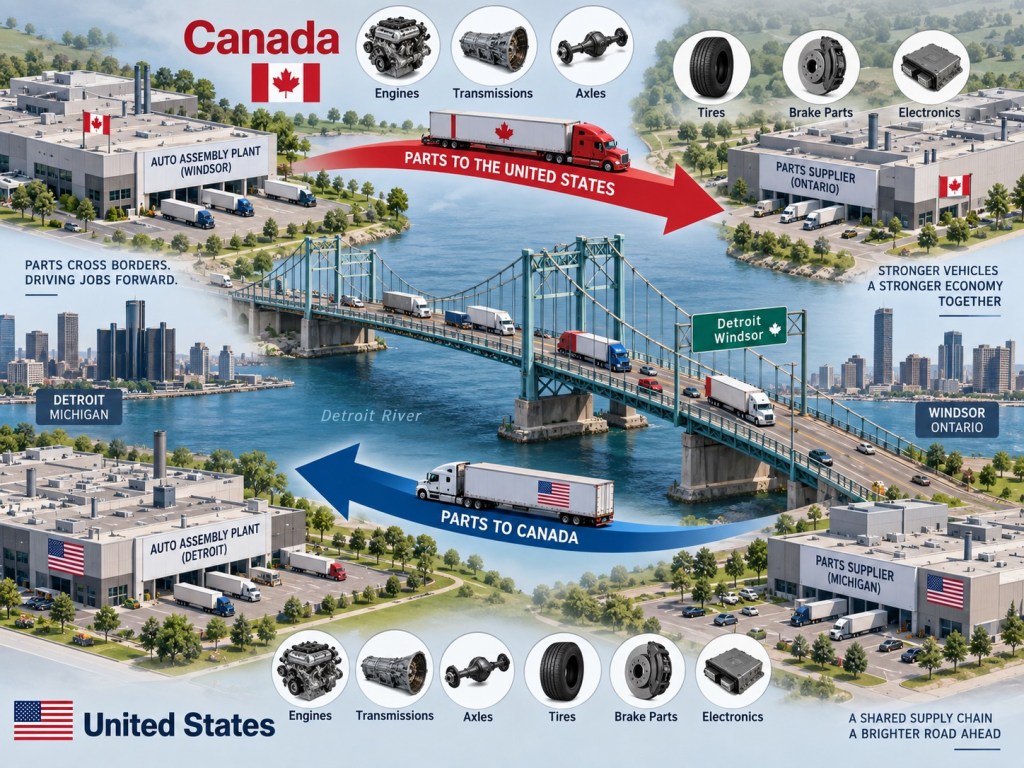
Image created by ChatGPT
Economic relations between the United States and Canada have not always been smooth, however. In particular, the substantial increases in U.S. tariff rates in 1930 and during the second Trump administration resulted in sharp reactions from the Canadian government.
In 1930, Congress passed and President Herbert Hoover signed into law the Smoot-Hawley Tariff. In retaliation, Canadian Prime Minister William Lyon Mackenzie King and the Liberal Party significantly raised tariffs on U.S. imports. (We discussed the Smoot-Hawley Tariff in this blog post last year.) In the July 1930 Canadian elections, as the effects of the Great Depression began to be felt, Richard Bedford Bennett, the leader of the Conservative Party campaigned on using tariff increases to increase production and reduce unemployment. In a campaign speech, Bennett argued, “You have
been taught to mock at tariffs and applaud free trade. Tell me, when did free
trade fight for you? You say our tariffs are only for the manufacturers; I will
make them fight for you as well. I will use them to blast a way into the markets
that have been closed to you.”
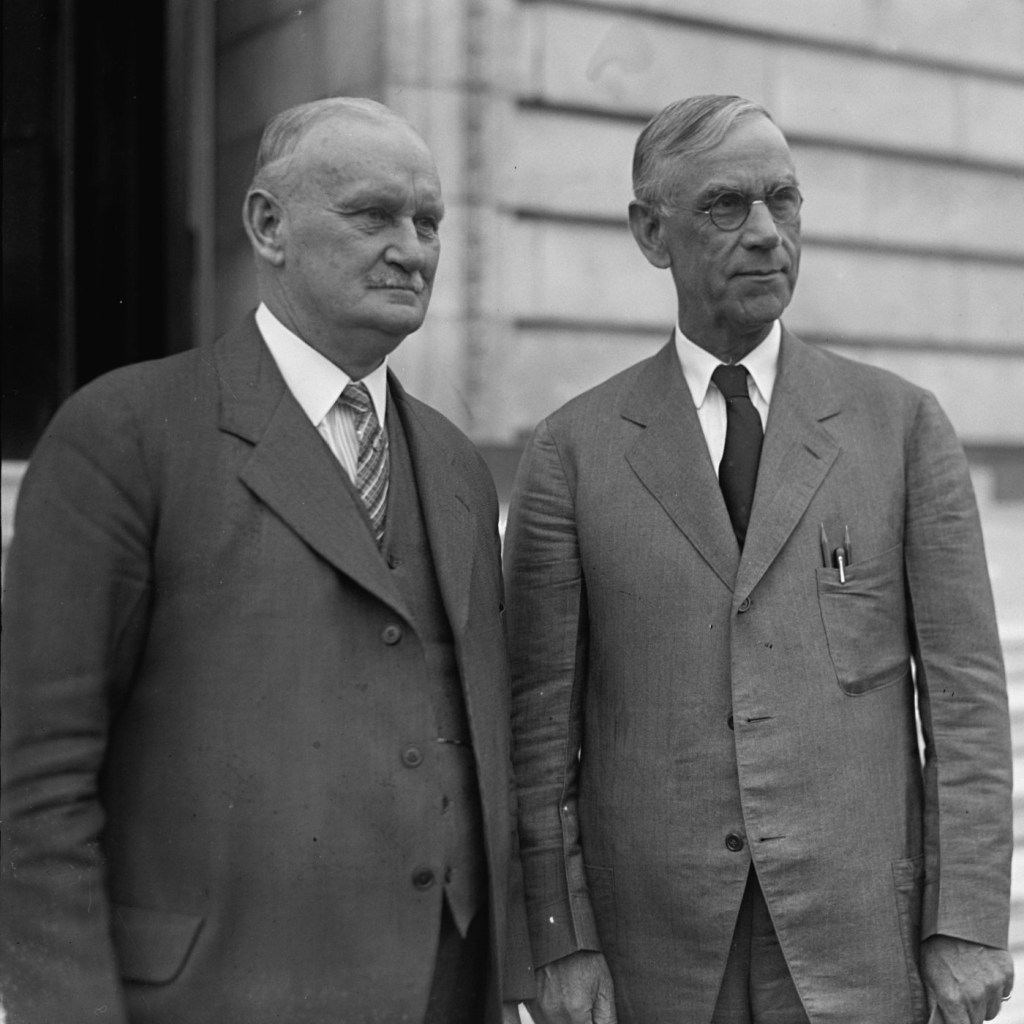
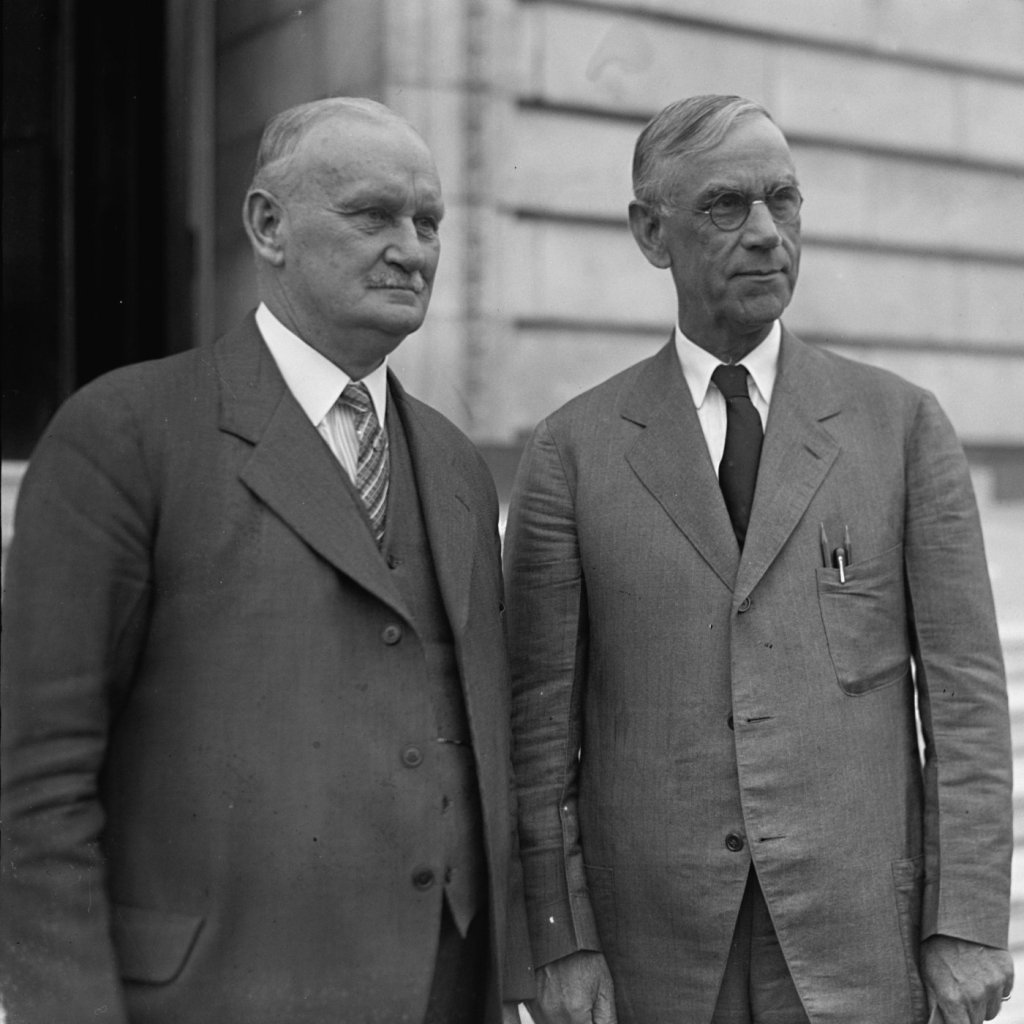
Photo of Congressman Willis Hawley of Oregon and Senator Reed Smoot from the U.S. Library of Congress via the Wall Street Journal.
The Conservatives won an overwhelming victory in the 1930 election, and the Canadian Parliament passed legislation that raised Canadian tariff rates on U.S. imports to the highest levels in history. Bennett hoped that Canada could replace the decline in exports to the United States with an increase in exports to the United Kingdom. The following two figures, from an academic paper Tony published with his Lehigh colleague Judith MacDonald, indicate the unlikelihood of Bennett’s plan succeeding. For most of the twentieth century up to 1930 (with the exception of the World War I period), the share of Canadian exports that went to the United Kingdom had been declining, while the share that went to the United States had been increasing. In addition, in 1930, more than 60 percent of Canadian imports came from the United States as opposed to less than 20 percent coming from the United Kingdom.
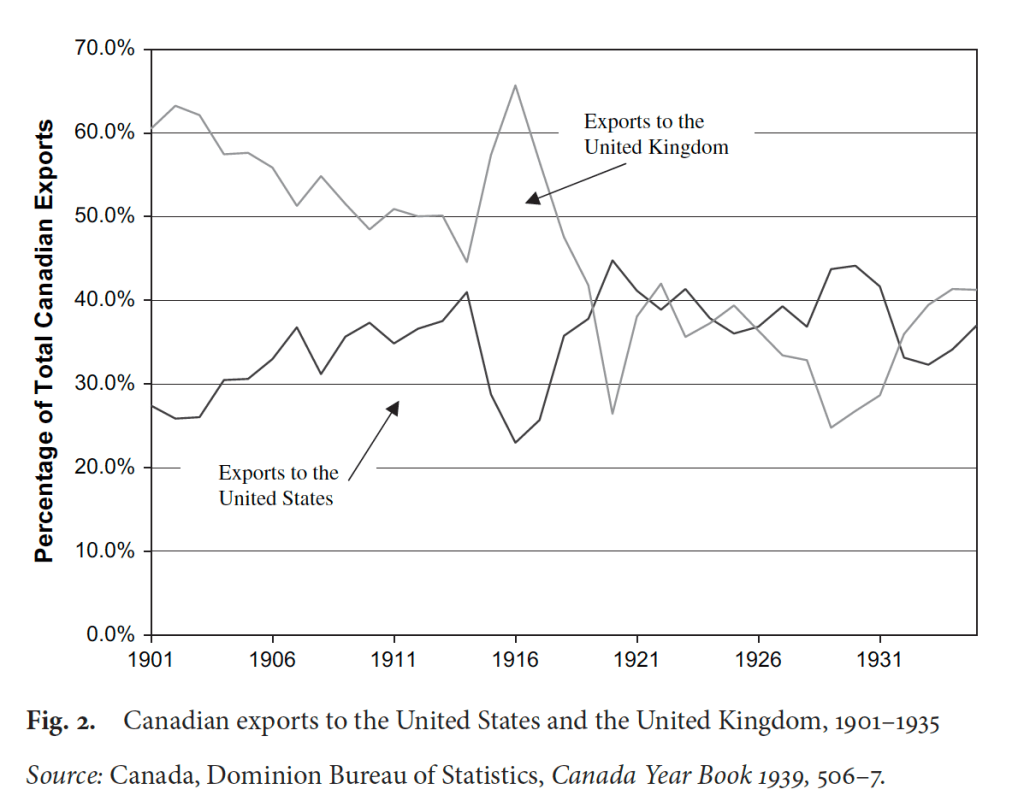
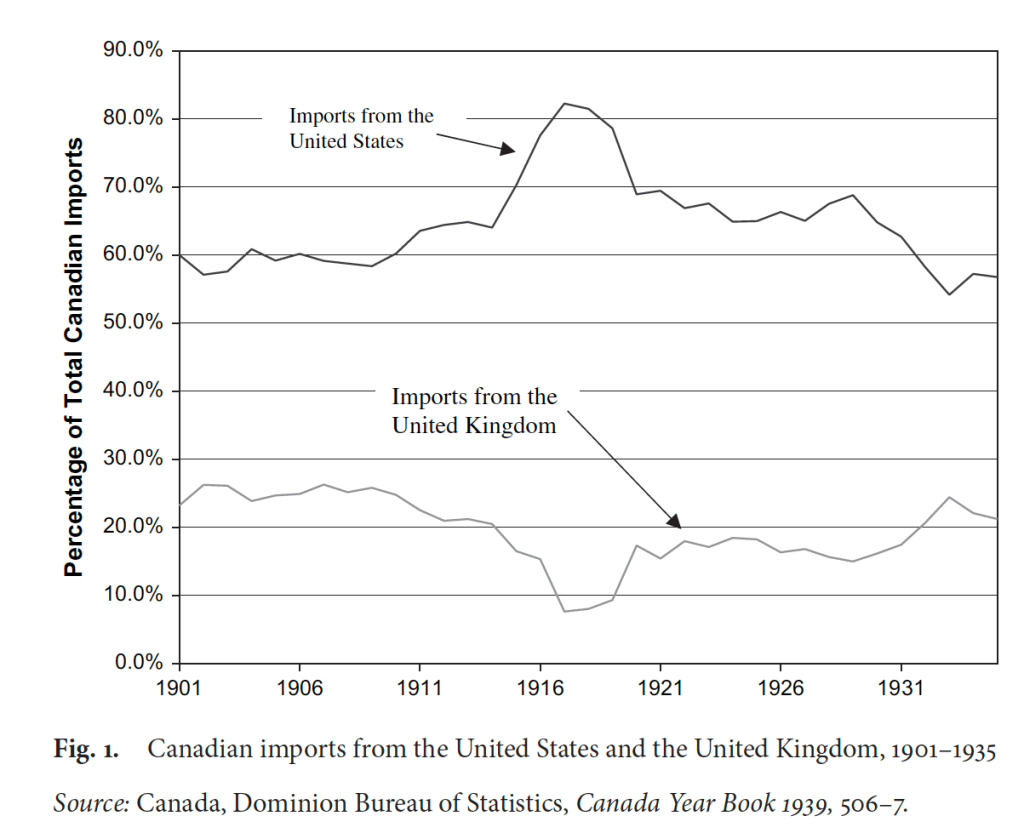
For reasons of geography and the long-established trading relations between U.S. and Canadian firms, a major reorienting of Canada’s trade away from the United States and toward the United Kingdom wasn’t feasible. By 1935, near the end of his five-term, Bennett pivoted to attempting to negotiate a reciprocal trade agreement with the United States that would result in both countries reducing their tariffs on each other’s products. An agreement was reached in November 1935, but that was too late for Bennett who had been voted out of office in July.
The higher tariffs that the Trump administration has imposed on Canadian imports has placed Canadian Prime Minister Mark Carney in a situation similar to that Bennett faced in 1930. Like Bennett, Carney has responded to the higher tariffs by increasing tariffs on imports from the United States. And like Bennett, Carney has tried to find new markets outside of the United States for Canadian exports. According to an article in the Wall Street Journal:
“Carney has instructed his special envoy to Europe to scope out the most ambitious possibilities short of full membership in the [European Union] or its common market, according to people familiar with the matter. The details are still being sketched by technical working groups for what the prime minister has told his aides will be the reorienting of an economy and a society that for half a century has been dominated by the U.S.”

ChatGPT generated this image of the European Parliament building in Brussels, Belgium.
Carney’s plan of shifting Canadian exports from the United States to the European Union (EU) faces obstacles similar to those faced by Bennett as he attempted to substitute markets in the United Kingdom for markets in the United States. As the following figures show, in 2025, more than 70 percent of Canadian exports of goods went to the United States, while less than 6 percent went to the EU. Similarly, about 45 percent of the Canadian imports of goods were from the United States, while less than 12 percent were from the EU.
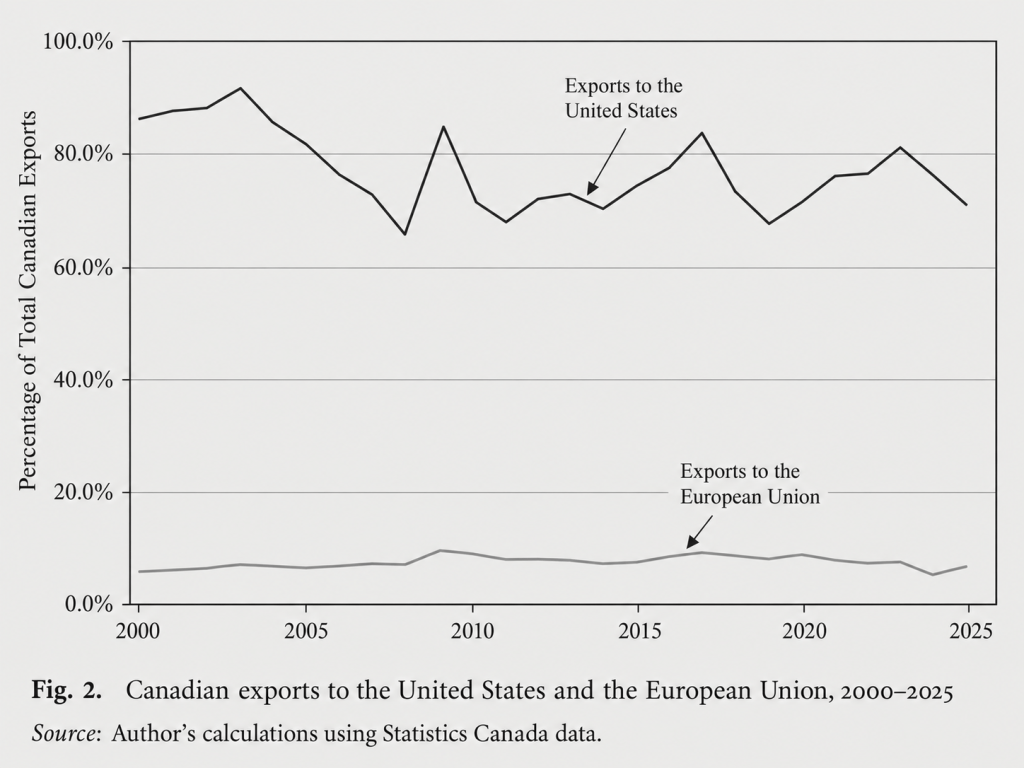
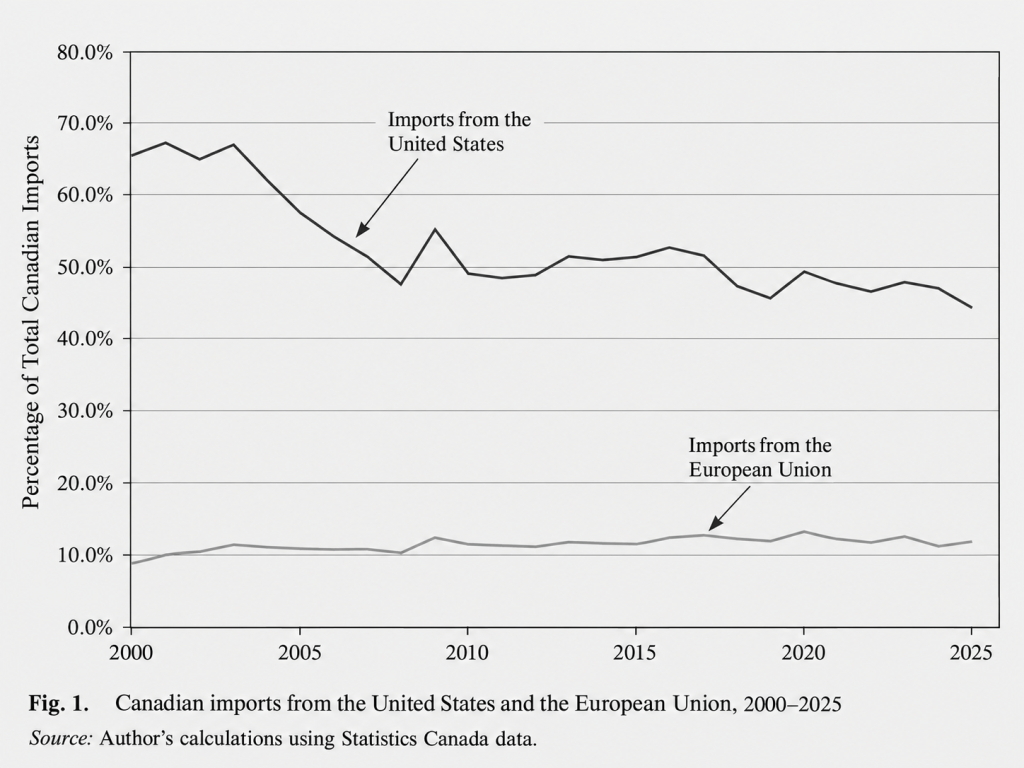
It may well be that Carney’s negotiations with officials in the EU are an attempt to push the United States into agreeing to reduce tariffs on Canadian imports. As a practical matter, though, it seems unlikely that Canada can reorient its trading relationships from the United Sates to the EU to any significant degree.