

Silver pennies used in England during the 600s. (Image from Jane Kershaw, et al.)
As economies move from subsistence agriculture towards specialization and trade, the inefficiency of barter exchange pushes them toward developing money. Any commodity that is widely accepted in payment for goods and services—that is, any commodity that can function as a medium of exchange—can be used as money. As we discuss in a recent blog post, in frontier America animal hides were used as money. In a World War II German prisoner of war camp, the British prisoners used cigarettes as money. Most economies made a transition from using commodities like animal skins to using coins made of precious metals, such as copper, silver, and gold. (We discuss the development of money in Macroeconomics, Chapter 14, Section 14.1, Economics, Chapter 24, Section 24.1, and Essentials of Economics, Chapter 16, Section 16.1.)
Coins were typically minted by kings, local warlords, bishops, or other people with control over a sufficient sized territory to make minting coins worthwhile. Where did they get the metal needed to mint coins? During the height of the gold standard in the 1800s and early 1900s, governments could rely on supplies of precious metals from domestic mines or from trade with other countries. In earlier periods, access to sufficient supplies of precious metals could be more difficult.
A recent academic paper by Jane Kershaw, of the University of Oxford; Stephen W. Merkel and Paolo D’Imporzano, of Vrije Universiteit Amsterdam; and Rory Naismith the University of Cambridge, examined the case of coins minted by kings of England during the year 660 to 820. During the time from the year 43 to the year 409, most of modern England and Wales was part of the Roman Empire. (A non-technical summary of the paper, with a video, is here. A timeline of Roman Britain is here.) During that time, the Roman province of Britannia used the same gold, silver, and copper coins used throughout the empire. After the withdrawal of the last Roman legions, England experienced waves of invasions from Saxons, Angles, and other Germanic tribes that destroyed most of Roman civilization on the island. Very few written records have survived from 409 through the end of the 500s. But it’s likely that few, if any, coins were minted during this period.
As trade within England began to revive in the second half of the 600s, the demand for coins increased. Given the inefficiency of barter, the absence of a sufficient supply of coins would have hobbled the growth of trade. With more than 200 years having passed since the end of Roman rule, Roman coins were no longer available in significant quantities. The increased demand for coins was met by silver pennies, like those shown in the photo at the top of this post.
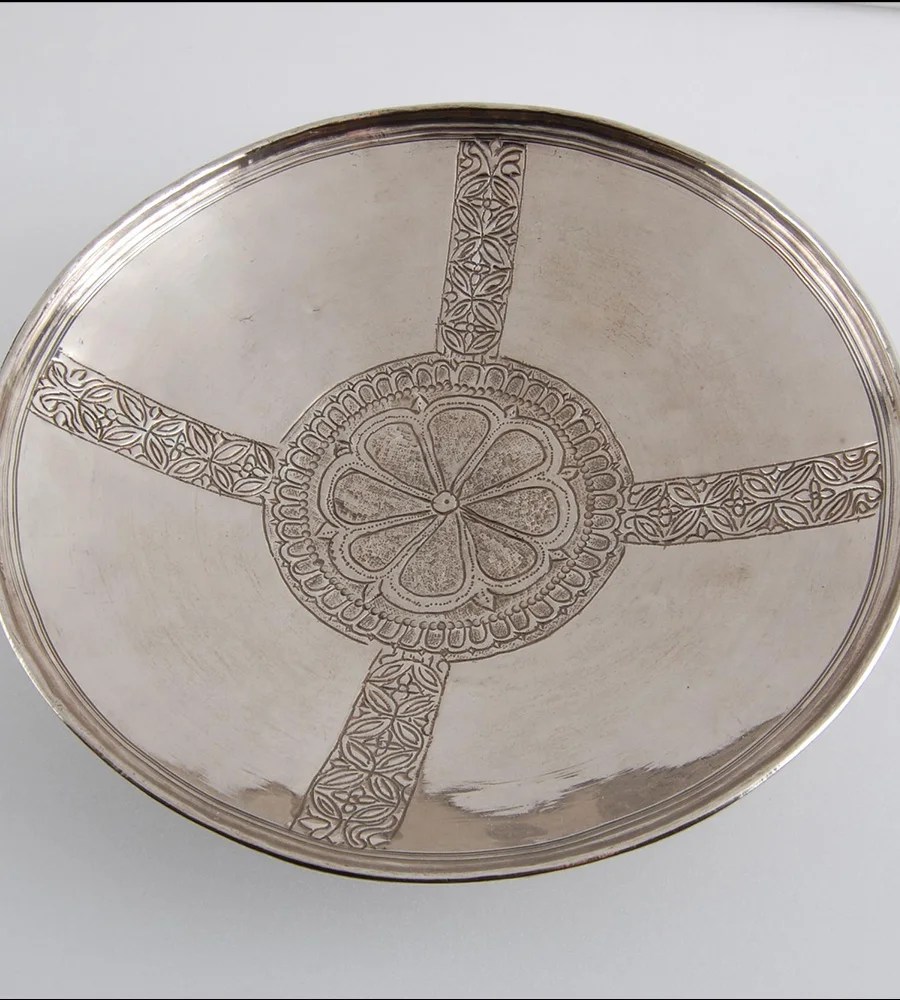
Where did the rulers of the various English kingdoms get the silver to mint pennies, given that there were no known silver mines operating during this period? Searching for clues, Jane Kershaw and her colleagues analyzed the composition of the silver used in the pennies. Surprisingly, the silver turned out to have the same composition as silver used in the Byzantine Empire in the eastern Mediterranean. Because in this period there was little to no trade between England and the Byzantine Empire, Kershaw and colleagues believe that the silver was likely obtained from melting silver objects, like the plate shown above, obtained from trade with the Byzantine Empire in earlier periods.
The work of these researchers has provided insight into an historical example of governments supplying the money needed to facilitate the transition away from barter.

 HubbardOBrienEconomics.com Blog