
Supports: Microeconomics and Economics, Chapter 14, Section 14.2.
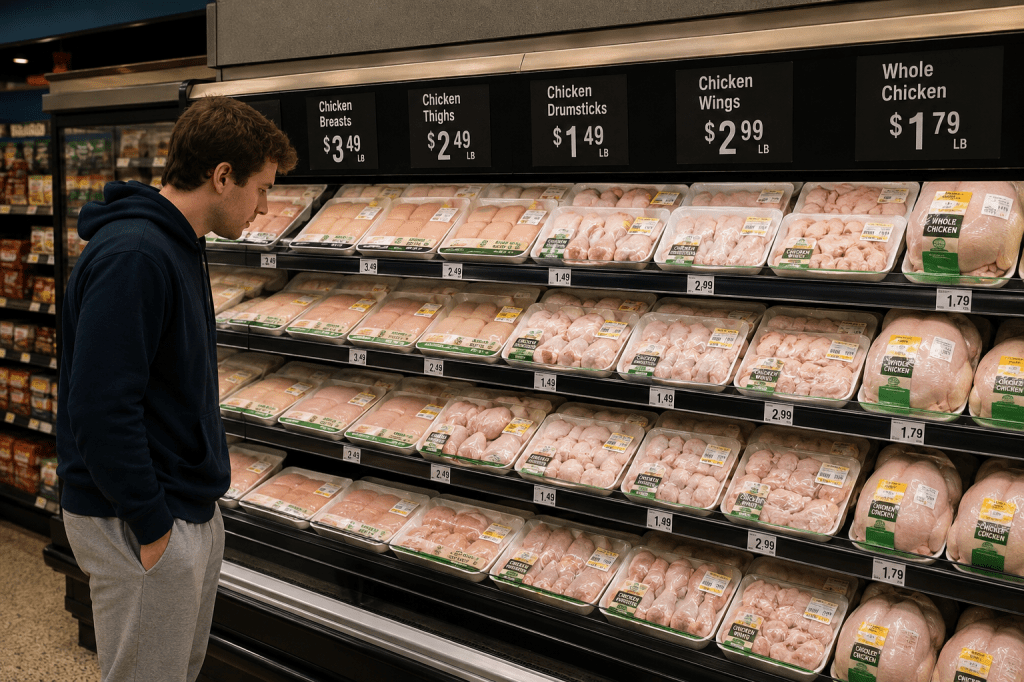
Image created by ChatGPT
An article in the Wall Street Journal discussed why the price of chicken in supermarkets has been falling. The article notes that, “Bigger chicken breeds and flocks not being decimated by disease over the summer have led to a glut in an industry that slaughters more than nine billion birds a year.” The article quotes an industry analyst who is critical of the decisions U.S. poultry famers. According to the analyst, “The industry shot themselves in the foot this year. All you had to do was just be disciplined around production.”
According to the U.S. Department of Agriculture, more than 150,000 farms in the United States sell at least some poultry and eggs, and more than 70,000 farms specialize in selling poultry and eggs.
a. What does the analyst mean by arguing that poultry famers should have been more “disciplined”? What does the analyst expect the result would have been of farmers having been more disciplined?
b. Given the information provided, why might poultry farmers have failed to be more disciplined?
Solving the Problem
Step 1: Review the chapter material. This problem is about the difficulty firms have in implicitly colluding if there are many firms in an industry, so you may want to review Chapter 14, Section 14.2, “Game Theory and Oligopoly.”
Step 2: Answer part a. by explaining what that analyst meant by poultry farmers having failed to have been “disciplined” and what he expected the result of farmers being more disciplined would have been. Given the context that U.S. poultry farmers had produced an unusually large number of chickens, the analyst is suggesting that if farmers had been more disciplined, they would have produced fewer chickens. Producing fewer chickens would have reduced the supply of chickens to the market and avoided the decline in chicken prices.
Step 3: Answer part b. by explaining why poultry farmers failed to be more disciplined. The information provided indicates that there are a large number of poultry farmers in the United States. As a result, the quantity of chickens produced by any one farmer is small relative to the total quantity of chickens produced in the market. Therefore, poultry farmers are price takers and no one poultry farmer is able to significantly affect the market price of chicken. (In Chapter 12, Section 12.1, we discuss why firms in a competitive market are price takers.) The only way for poultry farmers to have maintained chicken prices would have been to collude, either explicitly or implicitly, to produce fewer chickens. Explicit collusion is a violation of the antitrust laws and is unlikely to have been effective in any case because individual poultry farmers have a strong incentive to cheat on any agreement to restrict output. The same is true of an attempt by farmers to implicitly collude to restrict supply.

