Has AI Damaged the Tech Job Market for Recent College Grads?

Image generated by ChatGPT 5

“Artificial intelligence is profoundly limiting some young Americans’ employment prospects, new research shows.” That’s the opening sentence of a recent opinion column in the Wall Street Journal. The columnist was reacting to a new academic paper by economists Erik Brynjolfsson, Bharat Chandar, and Ruyu Chen of Stanford University. (See also this Substack post by Chandar that summarizes the results of their paper.) The authors find that:

“[S]ince the widespread adoption of generative AI, early-career workers (ages 22-25) in the most AI-exposed occupations have experienced a 13 percent relative decline in employment … In contrast, employment for workers in less exposed fields and more experienced workers in the same occupations has remained stable or continued to grow. Furthermore, employment declines are concentrated in occupations where AI is more likely to automate, rather than augment, human labor.”

The authors conclude that “our results are consistent with the hypothesis that generative AI has begun to significantly affect entry-level employment.”

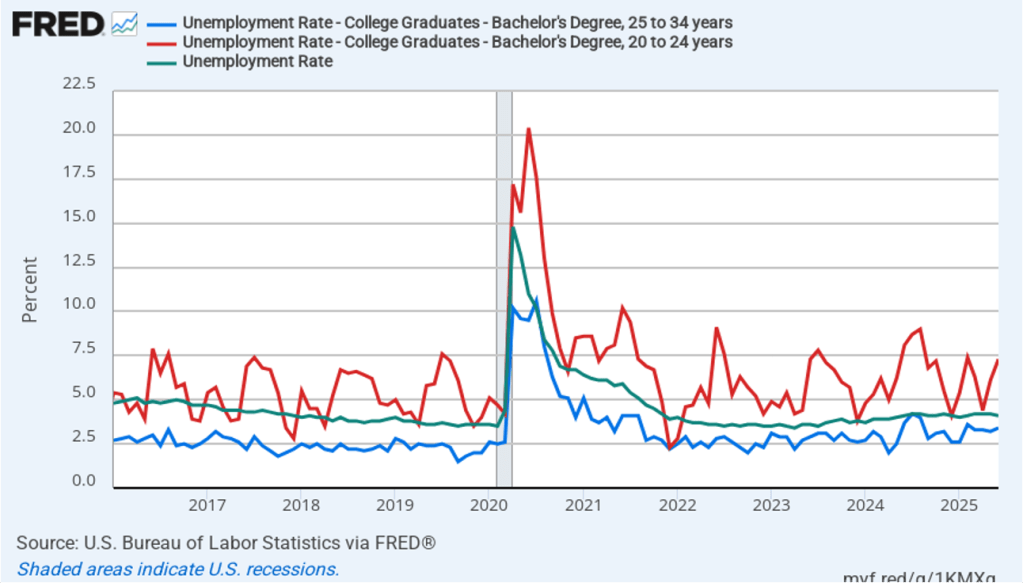
About a month ago, we wrote a blog post looking at whether unemployment among young college graduates has been abnormally high in recent months.  The following figure from that post shows that over time, the unemployment rates for the youngest college graduates (the red line) is nearly always above the unemployment rate for the population as a whole (the green line), while the unemployment rate for college graduates 25 to 34 years old (the blue line) is nearly always below the unemployment rate for the population as a whole. In July of this year, the unemployment rate for the population as a whole was 4.2 percent, while the unemployment for college graduates 20 to 24 years old was 8.5 percent, and the unemployment rate for college graduates 25 to 34 years old was 3.8 percent.
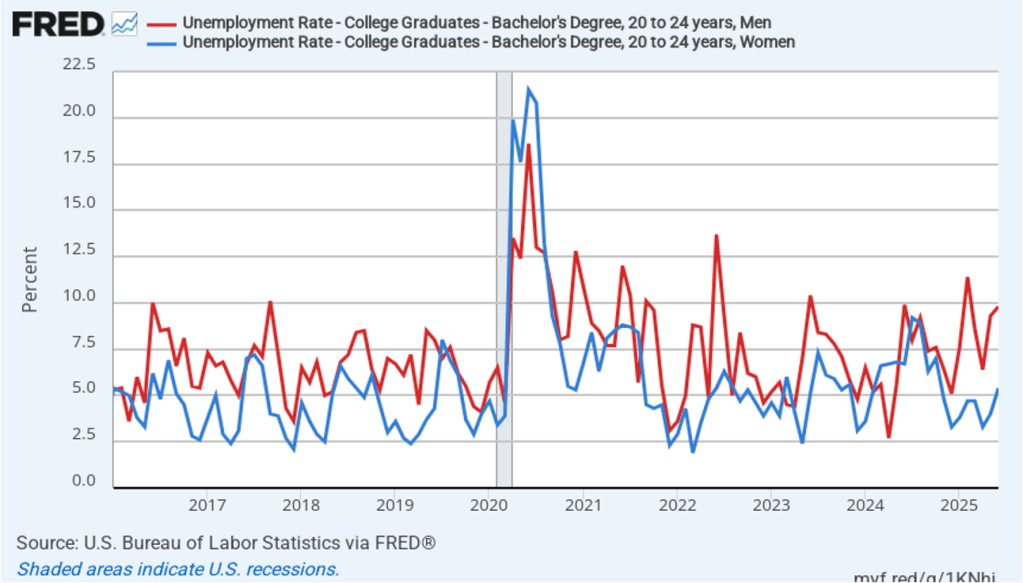
As the following figure (also reproduced from that blog post) shows, the increase in unemployment among young college graduates has been concentrated among males. Does higher male unemployment indicate that AI is eliminating jobs, such as software coding, that are disproportionately male? Data journalist John Burn-Murdoch argues against this conclusion, noting that data shows that “early-career coding employment is now tracking ahead of the [U.S.] economy.”
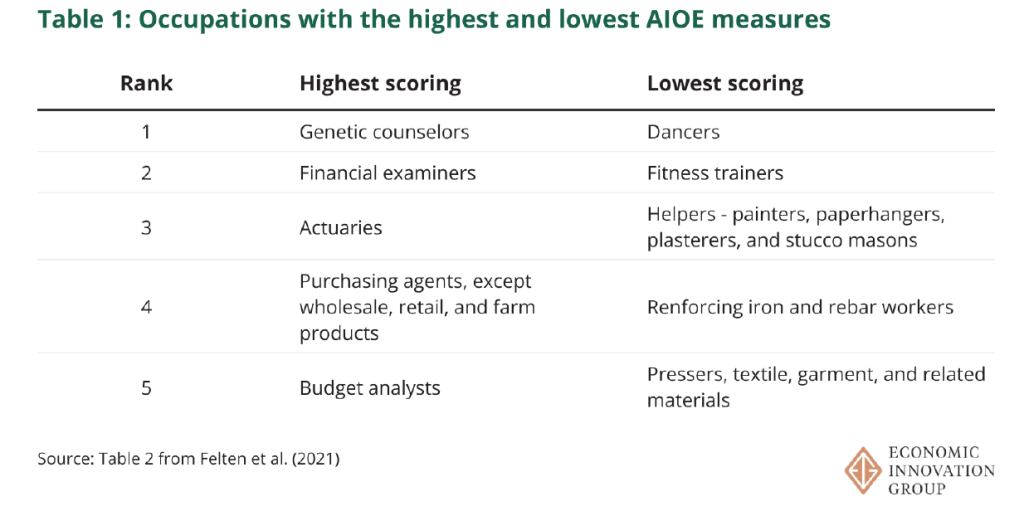
Another recent paper written by Sarah Eckhardt and Nathan Goldschlag of the Economic Innovation Group is also skeptical of the view that firms adopting generative AI programs is reducing employment in certain types of jobs. They use a measure developed by Edward Felton on Princeton University, and Manav Raj and Robert Seamans of New York University of how exposed particular jobs are to AI (AI Occupational Exposure (AIOE)). The following table from Eckhardt and Goldschlag’s paper shows the five most AI exposed jobs and the five least AI exposed jobs.
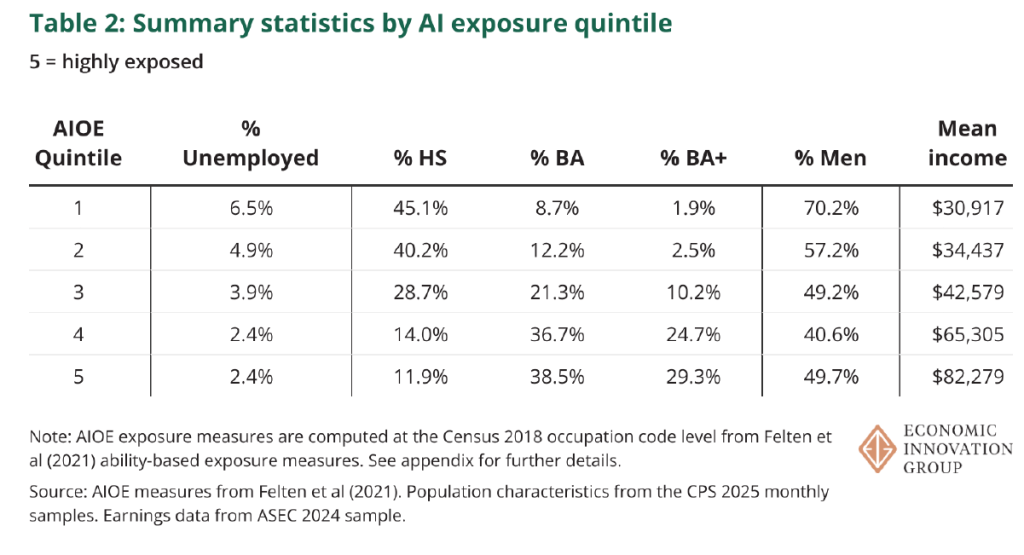
They divide all occupations into quintiles based on the exposure of the occupations to AI. Their key results are given in the following table, which shows that the occupations that are most exposed to the effects of AI—quintiles 4 and 5—have lower unemployment rates and higher wages than do the occupations that are least exposed to AI. 
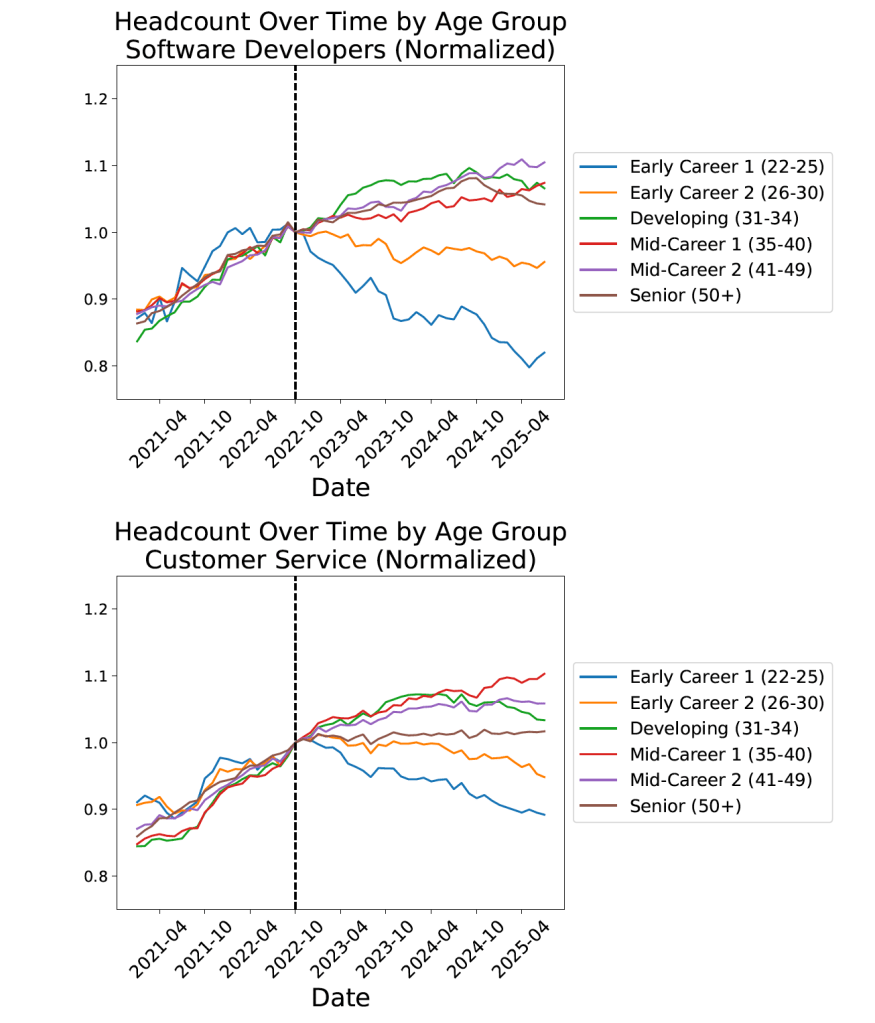
The Brynjolfsson, Chandar, and Chen paper mentioned at the beginning of this post uses a larger data set of workers by occupation from ADP, a private firm that processes payroll data for about 25 percent of U.S. workers. Figure 1 from their paper, reproduced here, shows that employment of workers in two occupations—software developers and customer service—representative of those occupations most exposted to AI declined sharply after generative AI programs became widely available in late 2022.
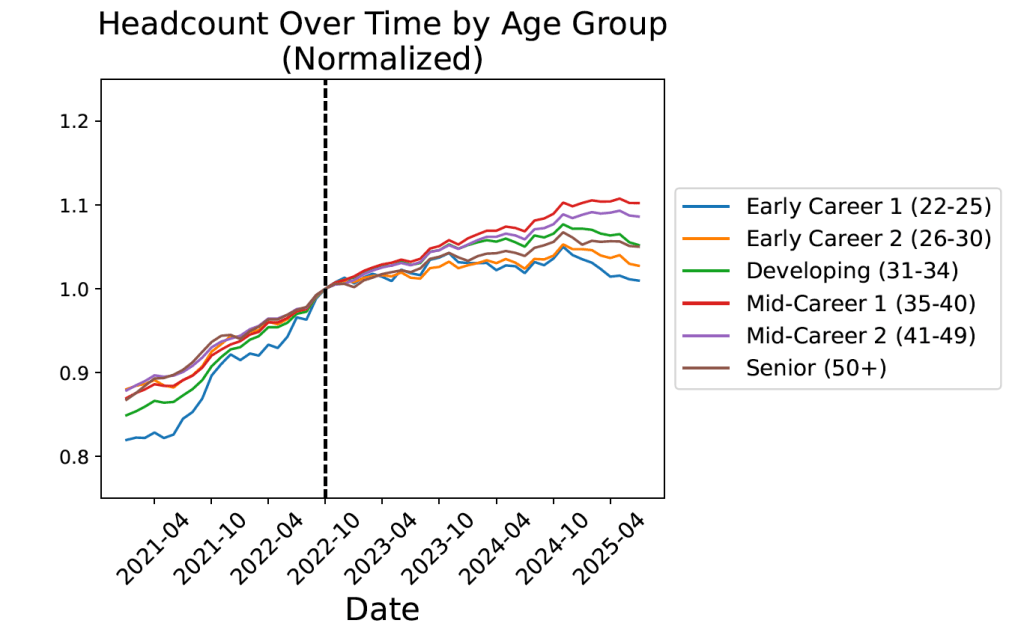
They don’t find this pattern for all occupations, as shown in the following figure from their paper.
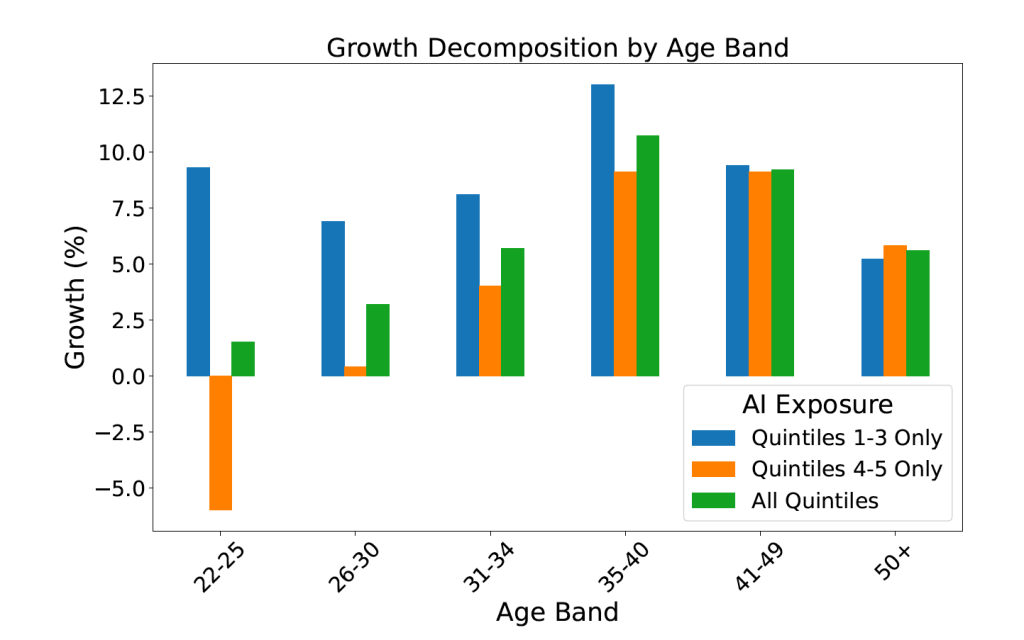
Finally, they show results by occupational quintiles, with workers ages aged 22 to 25 being hard hit in the two occupational quintiles (4 and 5) most exposted to AI. The data show total employment growth from October 2022 to July 2025 by age group and exposure to AI.
Economics blogger Noah Smith has raised an interesting issue about Brynjolfsson, Chandar, and Chen’s results. Why would we expect that the negative effect of AI on employment to be so highly concentrated among younger workers? Why would employment in the most AI exposed occupations be growing rapidly among workers aged 35 and above? Smith wonders “why companies would be rushing to hire new 40-year-old workers in those AI-exposed occupations.” He continues:

“Think about it. Suppose you’re a manager at a software company, and you realize that the coming of AI coding tools means that you don’t need as many software engineers. Yes, you would probably decide to hire fewer 22-year-old engineers. But would you run out and hire a ton of new 40-year-old engineers?

Both the papers discussed here are worth reading for their insights on how the labor market is evolving in the generative AI era. But taken together, they indicate that it is probably too early to arrive at firm conclusions about the effects of generative AI on the job market for young college graduates or other groups.

Does Majoring in Economics Increase Your Income?

Image by Andrea D’Aquino in the Wall Street Journal.

Studying economics provides students in any major with useful tools for understanding business decision making and for evaluating government policies. As we discuss in Chapter 1, Section 1.5 of Microeconomics, Macroeconomics, and Economics, majoring in economics can lead to a career in business, government, or at nonprofit organizations. Many students considering majoring in economics are interested in how the incomes of economics majors compare with the incomes of students who pursue other majors.

            The Federal Reserve Bank of New York maintains a web page that uses data collected by the U.S. Census to show the incomes of people with different college majors. The following table shows for economics majors and for all majors the median annual wage received by people early in their careers and in the middle of their careers. The median is a measure of the average calculated as the annual wage at which half of people in the group have a higher annual wage and half have a lower annual wage. “Early career” refers to people aged 22 to 27, and “mid-career” refers to people aged 35 to 45.  The data are for people with a bachelor’s degree only, so people with a masters or doctoral degree are not included.  

 Median Wage Early CareerMedian Wage Mid-Career
Economics majors$55,000$93,000
All majors$42,000$70,000

The table shows that early in their careers, on average, economics majors earn an annual wage about 31 percent higher than annual wage earned by all majors. At mid-career, in percentage terms, the gap increases slightly to 33 percent.

            How should we interpret these data? In Chapter 1, Section 1.3, in discussing how to evaluate economic models, we made the important distinction between correlation and causality. Just because two things are correlated, or happen at the same time, doesn’t mean that one caused the other. In this case, are the higher than average incomes of economics majors caused by majoring in economics or is majoring in economics correlated with higher incomes, but not actually causing the higher incomes. It might be true, for instance, that on average economics majors have certain characteristics—such as being more intelligent or harder workers—than are students who choose other majors. Because being intelligent and working hard can lead to successful careers, students majoring in economics might have earned higher incomes on average even if they had chosen a different major.

(Here’s a  more advanced point about identifying causal relationships in data: The problem with determining causality described in the previous paragraph is called selection bias. Students aren’t randomly assigned majors; they choose, or self-select, them. If students with characteristics that make it more likely that they will earn high incomes are also more likely to choose to major in economics, then the higher incomes earned by economics majors weren’t caused by (or weren’t entirely caused by) majoring in economics.)

            Economists Zachary Bleemer of the University of California, Berkeley and Aashish Mehta of the University of California, Santa Barbara have found a way to evaluate whether majoring in economics causes students to earn higher incomes. The authors gathered data on all the students admitted to the University of California, Santa Cruz (UCSC) between 2008 and 2012 and on their incomes in 2017 and 2018. To major in economics, students at UCSC needed a grade point average (GPA) of 2.8 or higher in the two principles of economics courses. The authors compared the choices of majors and the average early career earnings of students who just met or just failed to meet the 2.8 GPA threshold for majoring in economics. The authors use advanced statistical analysis to reach the conclusion that: “Comparing the major choices and average wages of above-and-below-threshold students shows that majoring in economics caused a $22,000 (46 percent) increase in annual early-career wages of barely above-threshold students.” 

            The authors attribute half of the higher wages earned by economics majors to their being more likely to pursue careers in finance, insurance, real estate, and accounting, which tend to pay above average wages.  The authors note that their findings from this study “imply that students’ major choices could have financial implications roughly as large as their decision to enroll in college ….”

Sources: Federal Reserve Bank of New York, The Labor Market for Recent College Graduates, https://www.newyorkfed.org/research/college-labor-market/index.html; and Zachary Bleemer and Aashish Meta, “Will Studying Economics Make You Rich? A Regression Discontinuity Analysis of the Returns to College Major,” American Economic Journal: Applied Economics, Vol. 14, No. 2, April 2022, pp. 1-22.

NEW! – 02/12/21 Podcast – Authors Glenn Hubbard & Tony O’Brien talk with early-career Econ graduate – Sydney Levine

Authors Glenn Hubbard and Tony O’Brien catch up with recent Econ graduate – Sydney Levine. Sydney received her undergraduate degree from SUNY-Geneseo and received her master’s from Johns Hopkins University School for Advanced International Studies. She is now a Consultant with Guidehouse LLC. Hear about the tools Sydney developed as an Economics student that aid her in tackling complex business challenges each day with her management consulting team. She also offers insight into which courses helped most in developing her economic view. Glenn and Tony offer thoughts on Adam Smith and other topics during the discussion.

Just search Hubbard O’Brien Economics on Apple iTunes or any other Podcast provider and subscribe!

Please listen & share!

11/13/20 Podcast – Authors Glenn Hubbard & Tony O’Brien talk with recent Econ graduates – Fernando Zuniga & Greg Mitchell

Authors Glenn Hubbard and Tony O’Brien catch up with two recent Penn State University Economics graduates – Fernando Zuniga & Gregory Mitchell. They discuss their path through their econ courses – what interested them, what they learned, and what’s been helpful as they begin their careers. They also discuss their careers – how they got there and what econ principles have offered insight in their roles. Students and instructors will gain more insight from this conversation around learning economics and the career paths chosen.

Just search Hubbard O’Brien Economics on Apple iTunes or any other Podcast provider and subscribe!

Please listen & share!