
Image created by ChatGPT
By the early 1950s, a majority of American households owned television sets. For many years, the only way you could view an episode of a series or a movie was to watch it at the time it was broadcast. Television networks typically broadcast only one episode of a series per week and broadcast new episodes only during the prime-time hours from 7:30 pm to 11:00 pm. (There were a few exceptions, such as the Batman series that the ABC network broadcast twice per week 1960s and the Who Wants to Be a Millionaire quiz show that ABC broadcast multiple times per week in the early 2000s.)
Image created by ChatGPT
In the late 1970s, first Sony and then other firms began selling videocassette recorders (VCRs), which for the first time allowed people to both buy prerecorded movies and to record TV shows that they could play back whenever they chose to. In the late 1990s, first Toshiba, followed by Panasonic and Sony began to selling DVD players in the United States. The release of entire seasons of TV series on DVDs made it possible to binge watch by viewing multiple episodes in one sitting.
Image created by ChatGPT of a 1980s VCR
As we discuss in Microeconomics, Chapter 14, in 1997, Reed Hastings and Marc Randolph founded Netflix. For a subscription fee of $15.95 per month, a customer could rent four DVDs at a time, receiving and returning them through the mail. There was no limit on how long a customer could keep a DVD. This was an important contrast with Blockbuster and other bricks-and-mortar video rental stores, which charged a significant late fee if a video wasn’t returned within the three-day rental window.
In 2007, the spread of high-speed home Wi-Fi led Hastings to begin offering streaming as well as DVDs. By 2010, Netflix’s main subscription plan was streaming only and the company stopped renting DVDs in 2023. Netflix also pioneered in creating its own series, beginning in 2012 with Lilyhammer, a comedy drama about mobsters. Over the next few years, Netflix typically released an entire season’s worth of episodes at the same time, thereby facilitating binge viewing. As Hulu, HBO Max, Disney+, Apple TV+, and other streaming services entered the market, most followed the Netflix model of having no paid advertising and releasing a entire season’s worth of episodes at the same time. As more streaming services became available, sales of DVDs declined sharply. Between 2005 and 2018, DVD sales declined by 86 percent.

Photo of Netflix’s headquarters in Los Gatos, California in 2018 from Wikipedia.
Over time, though, the Netflix model has run into two problems. First, originally Netflix’s streaming plan, which included no advertising, was priced at $7.99 per month. Currently, Netflix charges $19.99 per month or $26.99 per month if you want to stream programs in 4K and on multiple devices. Other streaming services were charging similar prices. There are some consumers who are unwilling to pay those fees in addition to what they may paying for cable television or for other subscription services.
Second, releasing a season’s worth of episodes at one time increased the likelihood that some consumers would sign up for a service, watch all the episodes of that series, cancel their subscription, and then resubscribe only when another series they were interested in was released.
In June 2021, HBO Max was the first paid streaming service to offer an ad-supported tier at a lower subscription price. At that time, its ad-free plan had a price of $14.99 per month and its plan with ads had a price of $9.99 per month. In 2022, Netflix and Disney+ also began offering lower-priced plans with ads. Today, all the major streaming services other than Apple TV offer lower-priced plans with ads. Most streaming services now have a variety of plans. Because Disney also owns Hulu and ESPN, as the following chart shows, it may have the largest number of plans.
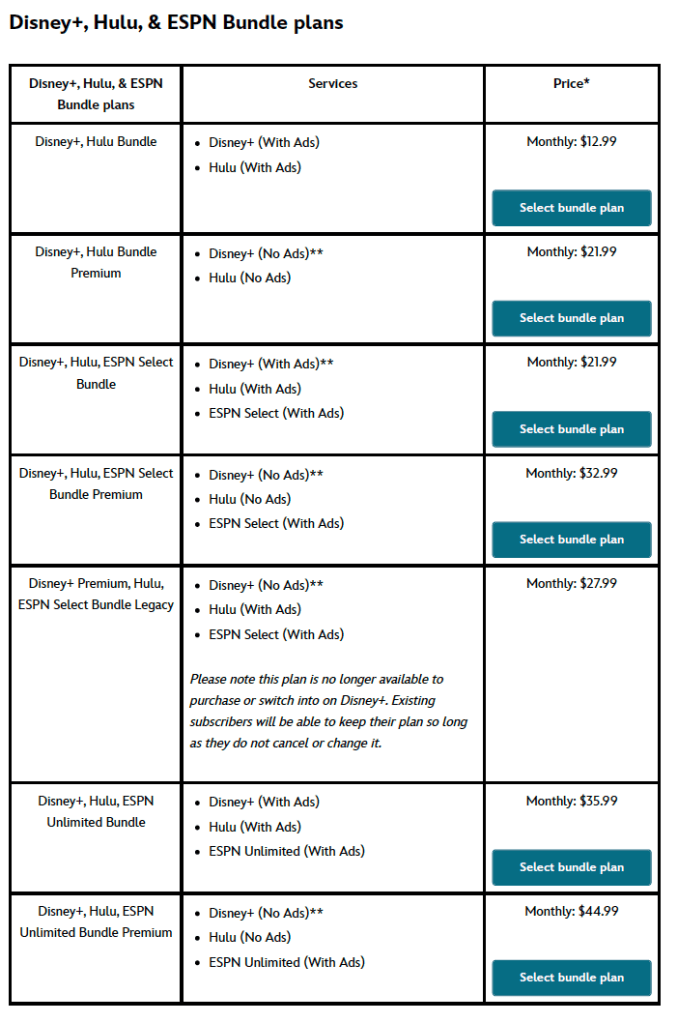
Table from disney+.com
Streaming services have also moved away from releasing all of a season’s episodes at once—binge releases—in favor of releasing one episode per week. The following chart from an article on axios.com shows a dramatic shift towards weekly releases and away from binge releases. In addition to reducing the number of people who subscribe for only a month, some industry analysts argue that weekly releases enhance the social aspect to watching streaming series. Many people like to talk with friends and family or online about a new series. Those interactions are improved if everyone involved has seen the same number of episodes rather than some people having binged the series while others are watching episodes over a longer period of time.
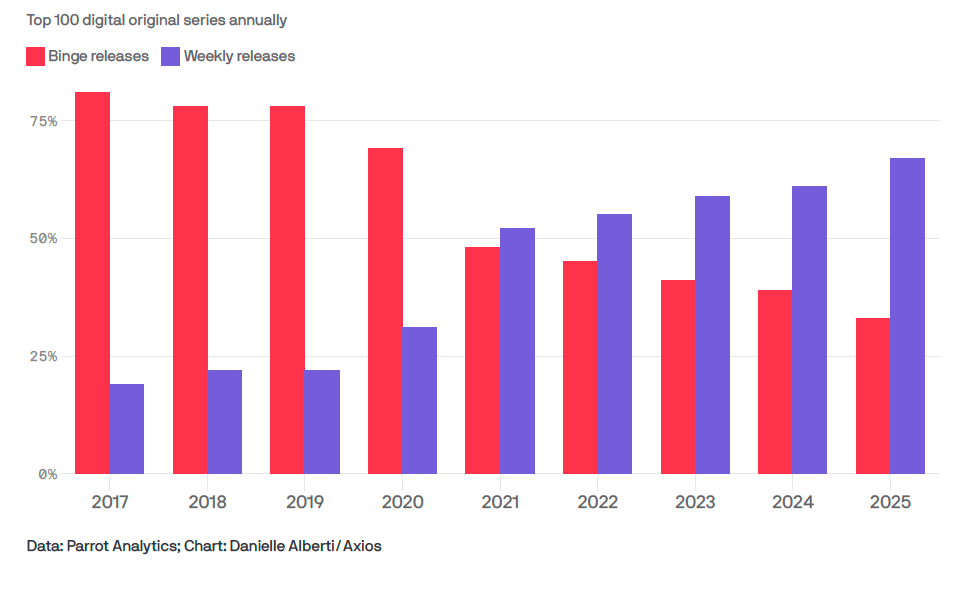
Graph from axios.com
Note that as firms offering video streaming have begun offering plans that include advertising and as they have moved away from binge releasing episodes, they have moved much closer to the approach that television networks have used since the early days of broadcast television. This development may be unsurprising because watching programing the traditional way remains popular with many consumers. According to data from the Nielsen company, broadcast television and cable television currently have about a 36 percent share of viewers and produce more than 60 percent of all new programs.
The evolution of the market for video steaming illustrates several points that we discuss in the text.
- As an industry evolves, firms learn more about their customers. As we saw in Microeconomics, Chapter 6, Tesla and other sellers of electric vehicles (EVs) were initially uncertain about how price elastic the demand for EVs is. In a similar way, streaming firms have discovered that they could reduce the number of series they binge release, thereby reducing the number of people who subscribe only for one or two months, without losing significant numbers of long-term subscribers.
- As we saw in Microeconomics, Chapter 15, firms attempt to price discriminate by segmenting the market for their products in order to charge higher prices to consumers who have a lower price elasticity of demand. The multiple plans that streaming firms offer are a type of price discrimination.
- As we saw in Microeconomics, Chapters 13 and 14, to succeed, firms have to differentiate their products from those sold by competing firms. Netflix pioneered in streaming video and had an initial advantage over competitors by having a large base of consumers who were already familiar with the firm from using their DVD rental service. But over time multiple competitors have entered the market for streaming video, which has slowed Netflix’s growth. The company responded by expanding its offerings beyond movies and series to include video games, live sports, and podcasts. But recently, Ted Sarandos, the firm’s co-CEO, announced layoffs to reduce costs and replaced the executive responsible for streaming content. According to an article in the Wall Street Journal, Sarandos has “emphasized that the streaming giant is mainly focused on its ‘core’ offerings—TV shows and movies—to grow its business.”


