
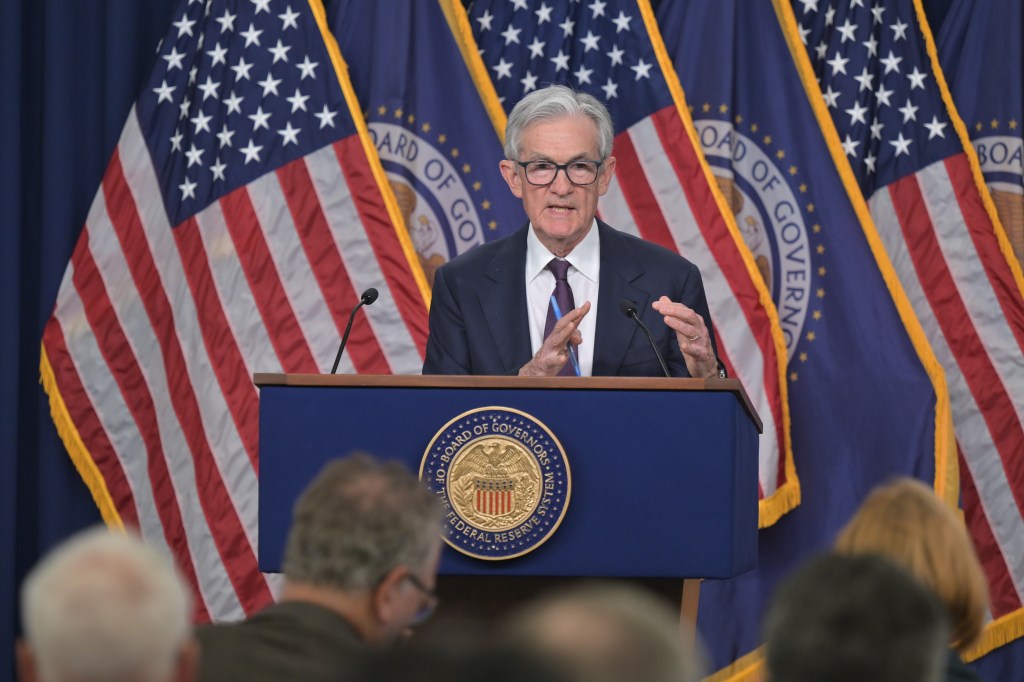
Photo of Federal Reserve Chair Jerome Powell from federalreserve.gov
Can a president fire the chair of the Federal Reserve in the same way that presidents have been able to fire cabinet secretaries? President Donald Trump has had a contentious relationship with Fed Chair Jerome Powell. Powell’s term as Fed chair is scheduled to end in May 2026. At times, Trump has indicated that he would like to remove Powell before Powell’s term ends, although most recently he’s indicated that he won’t do so.
Does Trump, or any president, have the legal authority to replace a Fed chair before the chair’s term expires? As we discuss in Macroeconomics, Chapter 27 (Economics Chapter 17), according to the Federal Reserve Act, once a Fed chair is nominated to a four-year term by the president (President Trump first nominated Powell to be chair in 2017 and Powell took office in 2018) and confirmed by the Senate, the president cannot remove the Fed chair except “for cause.” As we’ve noted in previous blog posts, most legal scholars argue that a president cannot remove a Fed chair due to a disagreement over monetary policy.
But if the Fed is part of the executive branch of the federal government and the president is the head of executive branch, why shouldn’t the president be able to replace a Fed chair. Article I, Section II of the Constitution of the United States states that: “The executive Power shall be vested in a President of the United States of America.” The ability of Congress to limit the president’s power to appoint and remove heads of commissions, agencies, and other bodies in the executive branch of government—such as the Federal Reserve—is not clearly specified in the Constitution. In 1935, a unanimous Supreme Court ruled in the case of Humphrey’s Executor v. United States that President Franklin Roosevelt couldn’t remove a member of the Federal Trade Commission (FTC) because in creating the FTC, Congress specified that members could only be removed for cause. Legal scholars have presumed that the ruling in this case would also bar attempts by a president to remove members of the Fed’s Board of Governors because of a disagreement over monetary policy.
Earlier this year, the Trump administration fired a member of the National Labor Relations Board (NLRB) and a member of the Merit Systems Protection Board (MSPB). The members sued and an appeals court ordered the president to reinstate the members. The Trump administration appealed the order to the Supreme Court, which on Thursday (May 22) granted a stay of the order on the grounds that “the Government is likely to show that both the NLRB and MSPB exercise considerable executive power,” and therefore can be removed by the president, when the case is heard by the lower court. The ruling indicated that a majority of the Supreme Court is likely to overturn the Humphrey’s Executor precedent either in this case, if it ends up being argued before the court, or in a similar case. (The Supreme Court’s order is here. An Associated Press article describing the decision is here. An article in the Wall Street Journal discussing the issues involved is here.)
Does the Supreme Court’s ruling in this case indicate that it would allow a president to remove a Fed chair? The court explicitly addressed this question, first noting that attorneys for the two board members had argued that “arguments in this case necessarily implicate the constitutionality of for-cause removal protections for members of the Federal Reserve’s Board of Governors or other members of the Federal Open Market Committee.” But the majority of the court didn’t accept the attorneys’ argument: “We disagree. The Federal Reserve is a uniquely structured, quasi-private entity that follows in the distinct historical tradition of the First and Second Banks of the United States.” (We discuss the First and Second Banks of the United States in Money, Banking, and the Financial System, Chapter 10.)
We discuss the unusual nature of the Fed’s structure in Macroeconomics, Chapter 14, Section 14.4, where we note that Congress gave the Fed a hybrid public-private structure and the ability to fund its own operations without needing appropriations from Congress. Fed Chair Powell clearly agrees that the Fed’s structure distinguishes its situation from that of other federal boards and commissions. Responding to a question following a speech in April, Powell indicated that he believes that the Fed’s unique structure means that a president would not have the power to remove a Fed chair.
It’s worth noting that the statement the court issued had the limited scope of staying the appeals court’s ruling that the members of the two commissions be reinstated. If a case arises that addresses directly the question of whether presidents can remove Fed chairs, it’s possible that, after hearing oral and written arguments, some of the justices may change their minds and decide that the president has that power. It wouldn’t be unusual for justices to change their minds during the process of deciding a case. But for now it appears that the Supreme Court would likely not allow a president to remove a Fed chair.
 HubbardOBrienEconomics.com Blog