
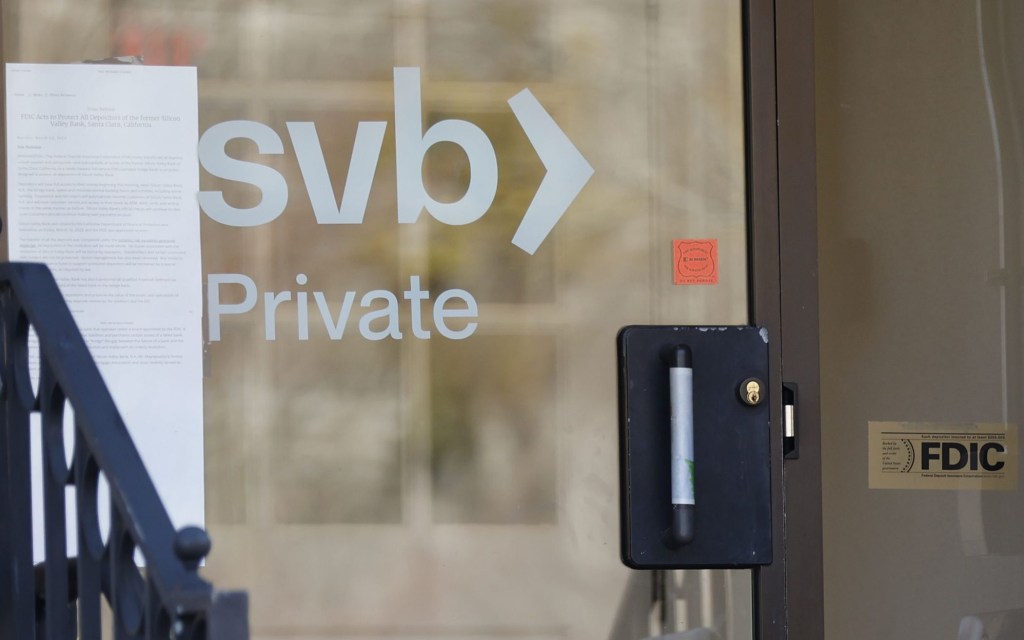
(Photo from the Wall Street Journal.)
This opinion column first appeared on barrons.com. It is also on the web site of the American Enterprise Institute.
Runs at Silicon Valley Bank and others emerged quickly and drove steep losses in regional bank equity values. Regulators shouldn’t have been caught by surprise, but at least they should take lessons from the shock. The subsequent ad hoc fixes to deposit insurance and assurances that the banking system is sufficiently well-capitalized don’t yet suggest a serious policy focus on those lessons. Calls for much higher levels of bank capital and tighter financial regulation notwithstanding, deeper questions about bank regulation merit greater attention.
Runs are a feature of banking. Banks transform short-term, liquid (even demandable) deposits into longer-term, sometimes much less liquid assets. Bank capital offers a partial buffer against the risk of a run, though a large-scale dash for cash can topple almost any institution, as converting blocks of assets to cash quickly to satisfy deposit withdrawals is almost sure to bring losses. The likelihood of a run goes up with bad news or rumors about the bank and correlation among depositors’ on their demand for funds back. That’s what happened at Silicon Valley Bank. Think also George Bailey’s impassioned speech in the classic movie It’s a Wonderful Life, explaining how maturity and liquidity transformations can unravel, with costs to depositors, bankers, and credit reductions to local businesses and households. The bank examiner in the movie, eager to get home, didn’t see it coming.
While bank runs and banking crises can be hard to predict, a simple maxim can guide regulation and supervision: Increase scrutiny in areas and institutions in which significant changes are occurring over a short period. On an aggregate level, the sharp, rapid increase in the federal funds rate since March 2022 should have focused attention on asset values and interest rate risks. So, too, should the fast potential compression in values of office real estate in many locations as a consequence of pandemic-related working shifts and rate hikes. At the bank level, significant inflows of deposits—particularly uninsured deposits—merit closer risk review. This approach isn’t limited to banking. A recent report of the Brookings-Chicago Booth Task Force on Financial Stability, co-chaired by Donald Kohn and me, put forth a similar change-based approach to scrutiny of nonbank financial institutions.
Such an approach would have magnified supervisory attention to Silicon Valley Bank and First Republic Bank . It also suggests the desirability of greater scrutiny and stress testing of midsize banks generally facing interest rate and commercial real estate risk. Those stress tests can give the Fed and the Federal Deposit Insurance Corp. an indication of capital adequacy concerns that could give rise to mergers or bank closures.
Even with this enhanced regulatory and supervisory attention, two major questions remain: For bank liabilities, what role should deposit insurance play in forestalling costly runs? For bank assets, what role should banks play in commercial lending?
Actions taken since Silicon Valley Bank’s collapse have effectively increased deposit-insurance guarantees for troubled institutions. But the absence of a clearer policy framework for dealing with uninsured deposits dragged out the unwinding of First Republic Bank and threatens other institutions experiencing rapid deposit increases and interest rate risk. When regulators asserted in the wake of the runs that the status quo of a $250,000 limit remained unchanged, they lacked both credibility and a means to reduce uncertainty about future policy actions in a run. That makes runs at vulnerable institutions both more likely and more severe. One reform would be to increase deposit insurance limits for transaction accounts of households and small and midsize firms, as recently proposed by the FDIC. Of course, even this reform raises concerns about implementation, how to price the enhanced coverage, and whether supervision will shift toward the “focus on the changes” framework I outlined earlier.
Retaining a more modest role for deposit insurance raises a larger question: What role should banks play in business lending for working capital, investment, and commercial real estate? The FDIC is mandated to resolve bank failures at the least cost to the deposit-insurance fund, but following that path may lead to more mergers of vulnerable institutions into the nations’ largest banks. While consolidation may mitigate risks for depositors with greater diversification of deposits, it leaves open effects on the mix of lending. Knowing local borrowers better, small and midsize banks have a prominent local lending presence in commercial and industrial loans and real estate. Whether such projects would be financed in a similar mix by local branches of megabanks is a question. Congress should consider whether other alternatives might be reasonable. It might permit consolidation among smaller institutions, even if more costly in resolution in the near term to taxpayers. Or nonbank institutions could be permitted to play a role in resolving troubled banks. The latter mechanism should be considered, as nonbank asset managers like Blackstone or BlackRock could fund loans originated by local banks.
Two lessons for regulation loom large. The first is that attention should be paid to policy risk management as well as bank risk management in identifying areas of concern. Think easy money and the reach for yield, inflationary fiscal and monetary policy during the pandemic, and the Fed’s rapid-fire increase in short-term rates to combat stubborn inflation. Second, regulators and Congress need to be wary of both too much deposit insurance (with likely increased risk-taking and pressure on supervision) and too little deposit insurance (with likely jumps in banking concentration and disruption of local credit to businesses).
One can reasonably anticipate additional erosion of capital in non-money-center banks from rising interest rates and lower office real estate collateral values, hopefully motivating a quick grasp of these lessons. While banks don’t have to mark assets to market if current and can survive turbulence until monetary policy eases, potential runs can upset this equilibrium. Declining regional bank stock prices make this risk clear. Only good fortune or a more thoughtful policy stand in the way of additional bank distress and attendant credit supply reductions.
 HubbardOBrienEconomics.com Blog