Glenn and Catherine Wolfram Propose a New Tool in Bargaining with Russia

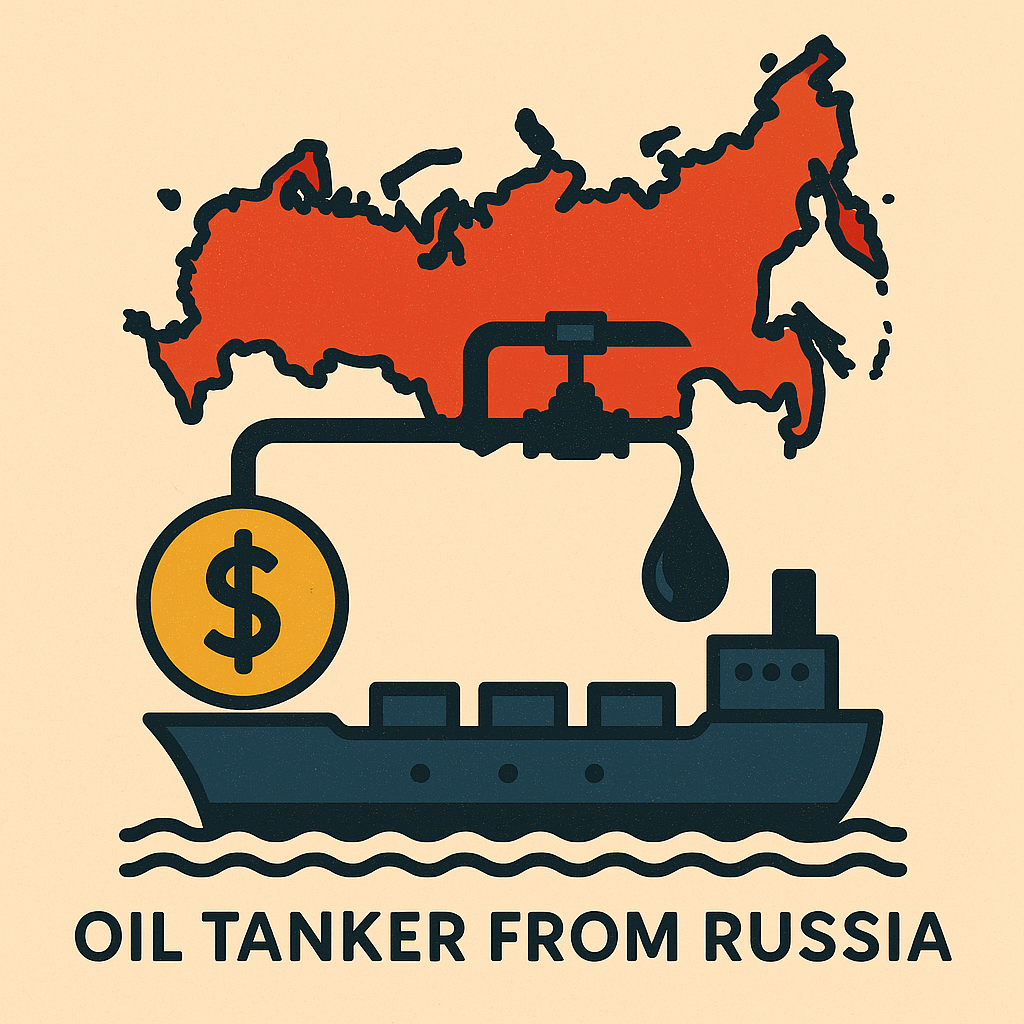
Image generated by ChatGTP-4o

How to Punish Russia, Make Money and End the War

Even though Russia and Ukraine were engaged in cease-fire talks with American representatives in Saudi Arabia, apparently with some progress on Tuesday, President Vladimir Putin of Russia has shown little actual commitment to ending his war.

President Trump needs some better cards.

Several weeks ago, the president floated the idea of sanctions and tariffs over Russian imports. But the Kremlin has been dismissive — mainly because the United States imports very little from Russia. Extensive financial and trade sanctions have been in place, most of them for around three years, and they are plainly not enough to bring peace.

Fortunately, there is a simple way to improve the American hand. The administration should impose sanctions on any company or individual — in any country — involved in a Russian oil and gas sale. Russia could avoid these so-called secondary sanctions by paying a per shipment fee to the United States Treasury. The payment would be called a Russian universal tariff, and it would start low but increase every week that passes without a peace deal.

Ships carry most Russian oil and gas to world markets. The secondary sanctions — if Russia does not make the required payments — would fall on all parties to the transaction, including the oil tanker owner, the insurer and the purchaser. Recent evidence confirms that Indian and Chinese entities — whose nations import considerable oil from Russia and have not imposed their own penalties on the Russian economy over the war in Ukraine — do not want to be caught up in American sanctions, making this idea workable. Another factor in its favor: All such tanker traffic is tracked carefully by commercial parties and by U.S. authorities.

Secondary sanctions are powerful tools: Violators can be cut off from the U.S. financial system, and they apply even to transactions that don’t directly involve American companies. They have been used to limit Iranian oil exports and to require that payments for Iranian oil be held in restricted accounts until sanctions were lifted. Our proposal would take this approach to another level. Under our plan, a portion of each Russian oil and gas sale would be paid to the U.S. Treasury until Russia agrees to a peace deal. The goal is to keep Russian oil flowing to global markets but with less money going to the Kremlin. The plan would sap Russia’s ability to continue waging war, and it puts money into U.S. government coffers.

In Russia, fossil fuel revenues and military spending are intertwined, although the country can also draw on its sovereign wealth fund and other sources. Fossil fuel exports provide the main source of dollar revenue for the Kremlin, which depends on hard currency to buy arms and other military supplies from abroad and pay for North Korean soldiers. The country currently exports about $500 million worth of crude oil and petroleum products and $100 million worth of natural gas every day. The Kremlin budgeted a slightly lower amount, almost $400 million per day for military spending in 2025.

The Russia universal tariff would provide money for the United States immediately, unlike the proposed Ukrainian critical minerals fund, which would take years to generate any returns. A fee of $20 per barrel of oil could generate up to $120 million per day (more than $40 billion per year), with additional revenue available if a similar fee is imposed on natural gas. Every dollar the United States collects is a dollar that Russia can’t spend to fund its war.

Ideally, the policy would pressure Russia into negotiations, where its removal could be part of a deal. If not, the United States would still collect billions annually, which could help fund Mr. Trump’s proposed tax cuts. In that scenario, Russia would effectively be helping repay the U.S. tax dollars used to provide aid to Ukraine to defend itself against Russia’s assault.

For the past three years, Western sanctions and public outcry, including some dockworkers’ refusal to unload Russian oil tankers, have forced Russia to search for new buyers and sell its oil at a discount compared with global prices. The oil discount averaged about $9 per barrel over the previous 12 months and was as high as $35 per barrel in April 2022. Despite receiving lower prices for its oil, Russia has maintained export volumes, ensuring a steady supply in the global oil market.

By imposing secondary sanctions unless the Russia universal tariff is paid, the United States would be taking a cut of the revenues, effectively increasing the discount on Russian oil. Russia’s continued exports, despite facing large discounts over the past three years, suggest it would continue exporting the same volume. That would keep global oil supply stable and help keep oil prices in check. Oil and gas in Russia are inexpensive to produce, and it relies heavily on the income they generate, so it has little option but to keep selling, even at lower prices.

While Mr. Trump can adopt this strategy, Congress can strengthen his negotiating position by passing a bill that puts the Russia universal tariff in place on its own. That would allow the president to protect his lines of communication with Mr. Putin by blaming the measure on Congress. He would also determine if and when he wants to sign the bill, giving him additional leverage over Russia. It’s possible the mere discussion of such a bill could help push the Kremlin toward a peace deal.

Combining secondary sanctions, a strong tool in the U.S. economic kit, with a tarifflike fee could pressure Mr. Putin by threatening his most valuable source of revenues. It would also make it easier for Mr. Trump to deliver on his promise of a lasting peace.

Catherine Wolfram, a former deputy assistant secretary for climate and energy in the Treasury Department, is a professor at M.I.T.’s Sloan School of Management.

This op-ed first appeared in the New York Times.

Is Vladimir Putin Acting Rationally?

Photo of Russian President Vladimir Putin from the Wall Street Journal.

On February 24, when Russian President Vladimir Putin launched an assault on Ukraine he apparently expected within a few days to achieve his main objectives, including occupying the Ukrainian capital of Kyiv and replacing the Ukrainian government. After three weeks, the fierce resistance of the Ukrainian armed forces have resulted in his failing to achieve these objectives. Although the Russian military had expected to experience few casualties or losses of equipment, in fact Russia has already lost more military personnel killed than the United States has since 2001 in Afghanistan and Iraq combined, as well as experiencing the destruction of many tanks, planes, and other equipment. 

The United States, the European Union, and other countries have imposed economic sanctions on Russia that have reduced the country’s ability to import or export most goods, other than oil and natural gas. The sanctions have the potential to reduce the standard of living of the average Russian citizen.

Most importantly, the war has killed thousands of Ukrainians and inflicted horrendous damage on many Ukrainian cities.

Despite all this, is Putin’s persistence in the invasion rational or if he were acting rationally would he instead withdraw his troops or accept a political comprise (at this writing, negotiations between representatives of Russia and Ukraine are continuing)?  First, recall the economic definition of rationality: People are rational when they take actions that are appropriate to achieve their goals given the information available to them. (We discuss rationality in Microeconomics, Chapter 10, Section 10.4, and in Economics, Chapter 10, Section 10.4.) Note that rationality does not deal with whether a person’s goals are good or bad. In this discussion, we are considering whether Putin is acting rationally in attempting to achieve the—immoral—goal of subjugating a foreign country.

Peter Coy, a columnist for the New York Times, discusses three reasons Putin may continue his attack on Ukraine even though, “The bloody invasion of Ukraine has been a disaster” for Putin. The first reason, Coy recognizes, involves an economic concept. His other two reasons can also be understood within the economic framework we employ in Microeconomics.

First, Coy argues that Putin may have fallen into one of the pitfalls to decision making we discuss in Chapter 10: A failure to ignore sunk costs. Coy notes that Putin may want to continue the attack to justify the death and destruction that has already occurred. However, those costs are sunk because no subsequent action Putin takes can reduce them. If Putin is continuing the attack for this reason, then Coy is correct that Putin is not acting rationally because he is failing to ignore sunk costs in making his decision. 

There is a subtle point, though, that Coy may be overlooking: Putin is effectively a dictator, but he may still believe he needs to avoid Russian public opinion turning too sharply against him. In that case, even if recognizes that he should ignore sunk costs he may believe that the Russian public may not be willing to ignore the costs of the death and destruction that has already occurred. In that case, his refusal to ignore this sunk cost be rational.

Coy’s second reason why Putin may continue the attack is that he may believe “just another few weeks of fighting will be enough to subdue Ukraine.”  Although Coy doesn’t discuss the point in these terms, it would be rational for Putin to continue the attack if he believes that the marginal benefit of doing so exceeds the marginal cost. (We discuss this point directly in Chapter 1, Section 1.1 “Optimal Decisions Are Made at the Margin,” and provided many examples throughout the text.)  The marginal cost includes the additional Russian military casualties and losses of equipment from prolonging the war and the cost of economic sanctions to the Russian economy. (It seems unlikely that Putin is taking into account the additional loss of life among Ukrainians and the additional devastation to Ukrainian cities from prolonging the war.)

The marginal benefit from continuing the attack would be either winning the war or obtaining a more favorable peace settlement in negotiations with the Ukrainian government. If Putin believes that the marginal benefit is greater than the marginal cost, he is acting rationally in continuing to attack. 

Coy’s final reason why Putin may continue the attack is that “he has little to lose by fighting on.” Although Coy doesn’t discuss the point in these terms, Russia may be suffering from a principal-agent problem. As we discuss in Microeconomics, Chapter 8, Section 8.1 (also Economics, Chapter 8, Section 8.1 and Macroeconomics, Chapter 6, Section 6.1) the principal-agent problem arises when an agent pursues the agent’s interst rather than the interests of the principal in whose behalf the agent is supposed to act. In this case, Putin is the agent and the Russian people are the principal. Putin’s own interest may be in prolonging the war indefinitely in the hopes of ultimately winning, despite the additional Russian soldiers who will be wounded or killed and despite the economic suffering of the Russian people resulting from the sanctions.

Although as president of Russia, Putin should be acting in the best interests of the Russian people, as a dictator, he can largely disregard their interests. Unlike his soldiers, Putin isn’t exposed to the personal dangers of being in battle. And unlike the average Russian, Putin will not suffer a decline in his standard of living because of economic sanctions.

Appalling as the consequences will be, Putin’s continuing his attack on Ukraine may be rational.

Sources: Peter Coy, “Here Are Three Reasons Putin Might Fight On,” New York Times, March 14, 2022; Alan Cullison, “Talks to End Ukraine War Pause as Russia’s Offensive Intensifies,” Wall Street Journal, March 14, 2022; and Thomas Grove, “Russia’s Military Chief Promised Quick Victory in Ukraine, but Now Faces a Potential Quagmire,” Wall Street Journal, March 6, 2022.