

Image generated by ChatGPT
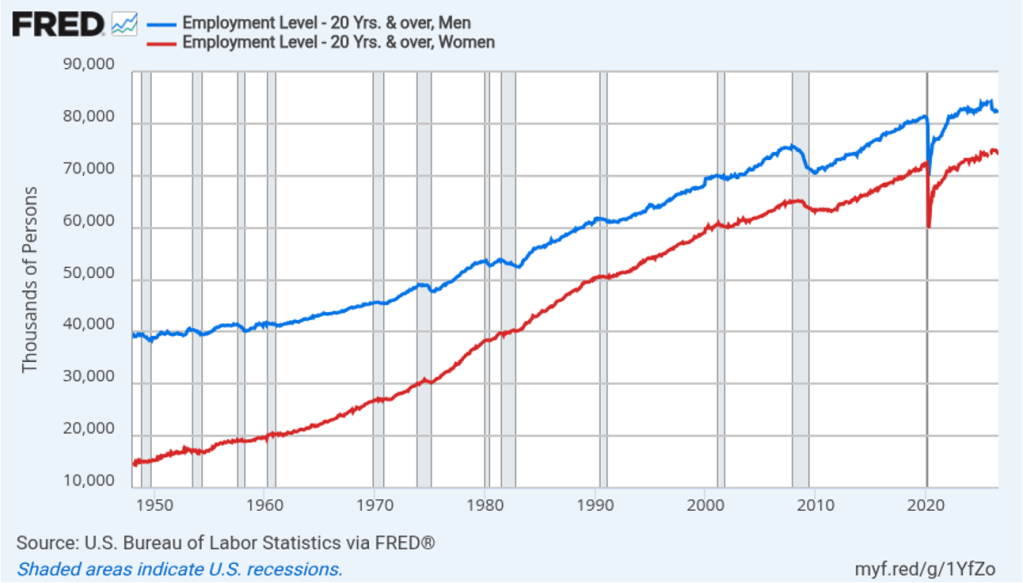
On this Labor Day, we look at an important issue: In recent years, women have been faring better than men in the job market. The following figure shows that, for workers 20 years and older, men still hold more jobs than women do, but the gap has been closing. For example, as measured by the household survey conducted by the Bureau of Labor Statistics (BLS), between January 2022 and August 2026, there was a net increase of 5,829,000 jobs in the United States. More than two thirds of those jobs were filled by women.
In recent months, the business press has begun to focus on this issue. Here are some recent headlines: “A Changing Job Market Leans Against Men,” “In This Job Market, Women Have the Upper Hand,” and “Young Men Are Abandoning the Workforce.” In Macroeconomics, Chapter 9 (Economics, Chapter 19), we discuss the employment-population ratio, which measures the fraction of the working-age population of a particular segment of the population that is employed. The following figure shows that the employment-population ratio for prime-age men—those aged 25 to 54—has been slowly trending downward for decades (the blue line), while that ratio has generally been increasing for women (the orange line).
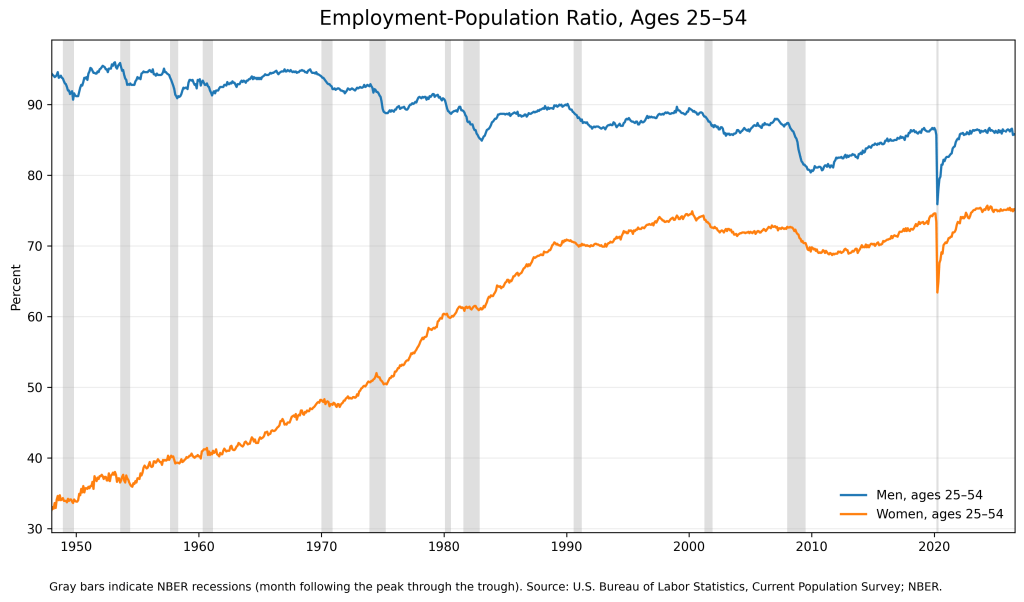
In March 1953, the employment-population ratio for prime-age males reached a peak of 96.0 percent. In August 2026, the ratio was 85.8 percent. If prime-age males were working in 2026 at the rate that they did in 1953, 10 million more men would be working today than actually are.
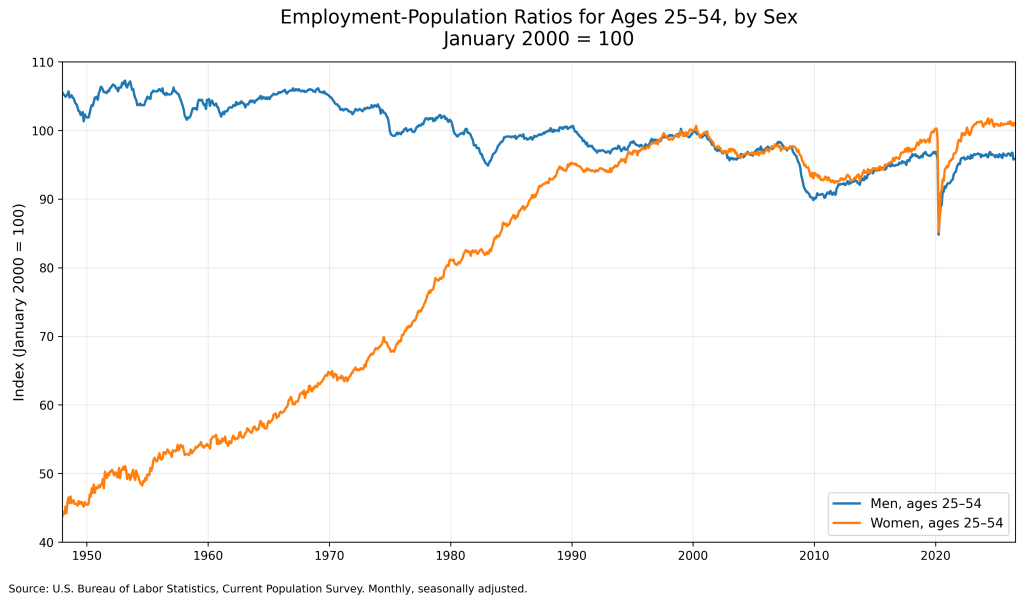
The following figure makes clearer the differing trends in men and women’s employment-population ratio in recent years. In this figure, the values for both ratios are set equal to 100 in January 2000. Since that time the employment-population ratio for prime-age women (the orange line) has increased by 1.1 percent, while the ratio for men (the blue line) has declined by 4.1 percent.
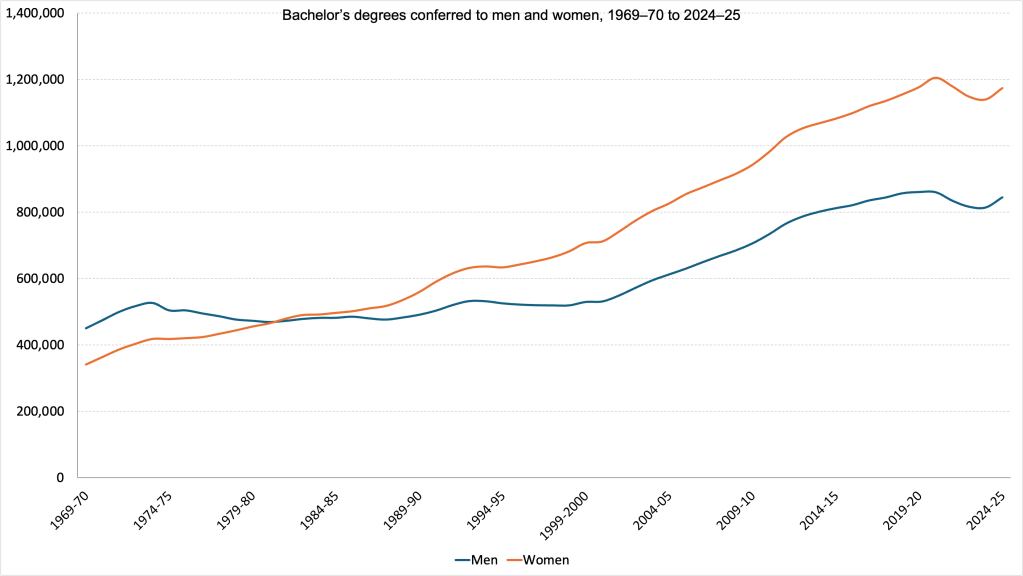
Why do a smaller fraction of prime-age men have jobs today than in the past? A large number of explanations have been offered, both in the business media and by academic economists. One key factor, as shown in the following figure, is that women (the orange line) are now more likely to earn a college degree than are men (the blue line).
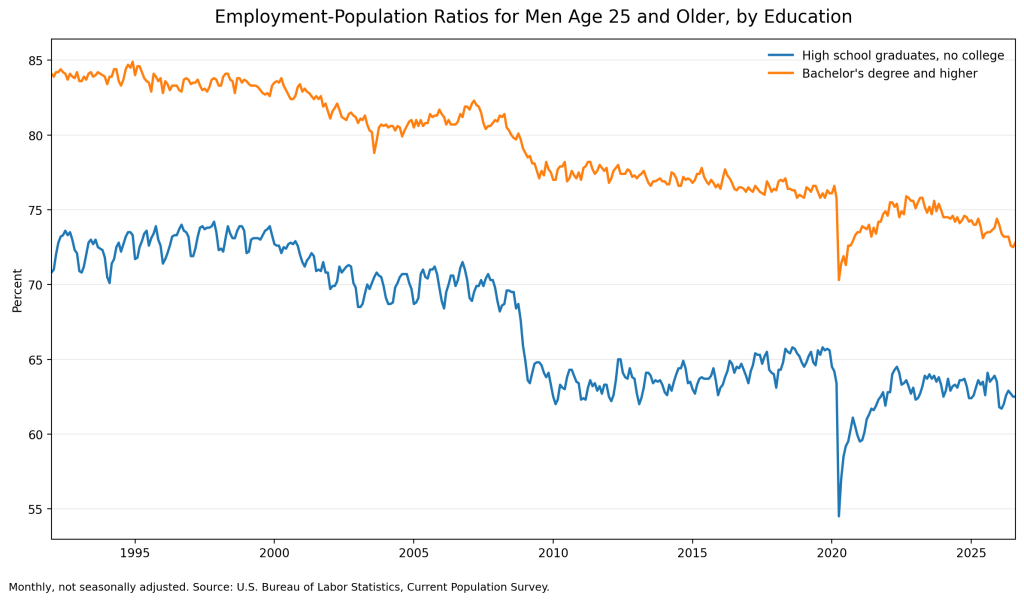
The fraction of jobs requiring a four-year degree has been increasing over time, a trend that the BLS projects will continue. As the following figure shows, men with a bachelor’s degree or more have a higher employment-population ratio than do men with only a high school degree. (Note that the data in this figure are for all men 25 years and older, not just for prime-age men. The average age of men has been rising, which lowers the employment-population ratio as an increasing fraction of men become of retirement age. These data are not available on a seasonally-adjusted basis, which accounts for the choppiness in the figure.) As men have fallen behind in earning college degrees, more men have found themselves unqualified to be hired in some jobs.
An article in the Wall Street Journal used BLS data to divide jobs primarily held by women and those primarily held by men. As the following figure from the article shows, jobs help primarily by women have been increasing faster than those held by men.
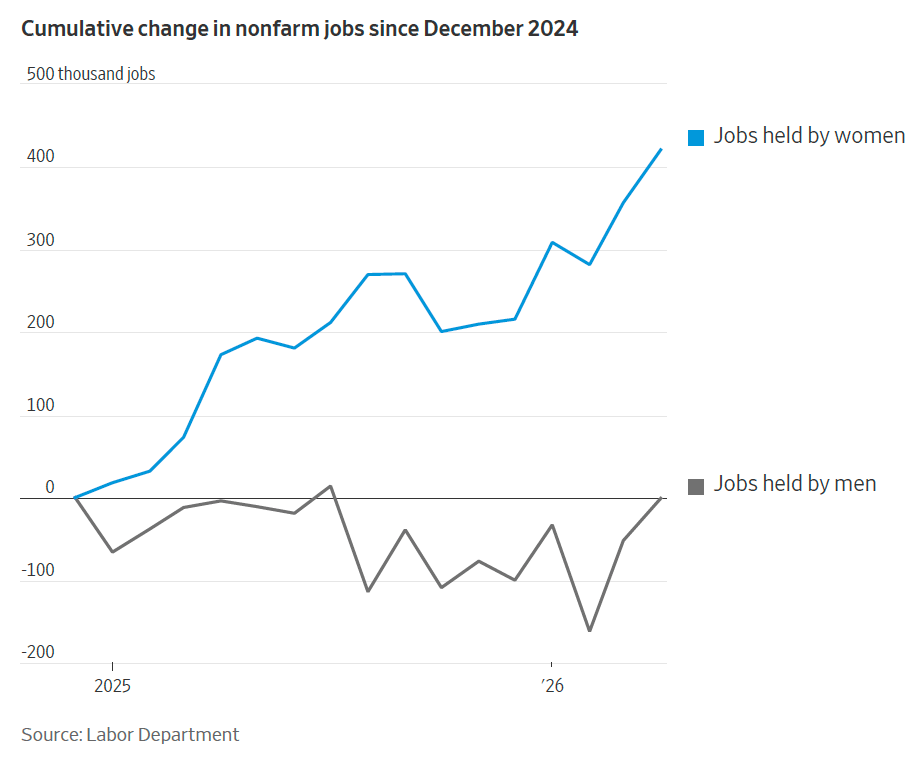

Image generated by ChatGPT
As we noted in a blog post earlier this year, health care jobs have come to dominate U.S. employment growth. The following figure shows monthly changes in health care and social assistance jobs (the blue bars) and monthly changes in total employment (the red bars) for each month since January 2025. During this time period, net employment in health care and social assitance increased by 1,027,300 jobs. All other job categories experienced a decrease of 268,300 jobs. Women account for 77.9 percent of health care and social assistance workers. In other words, the number of jobs in industries dominated by men have been declining.
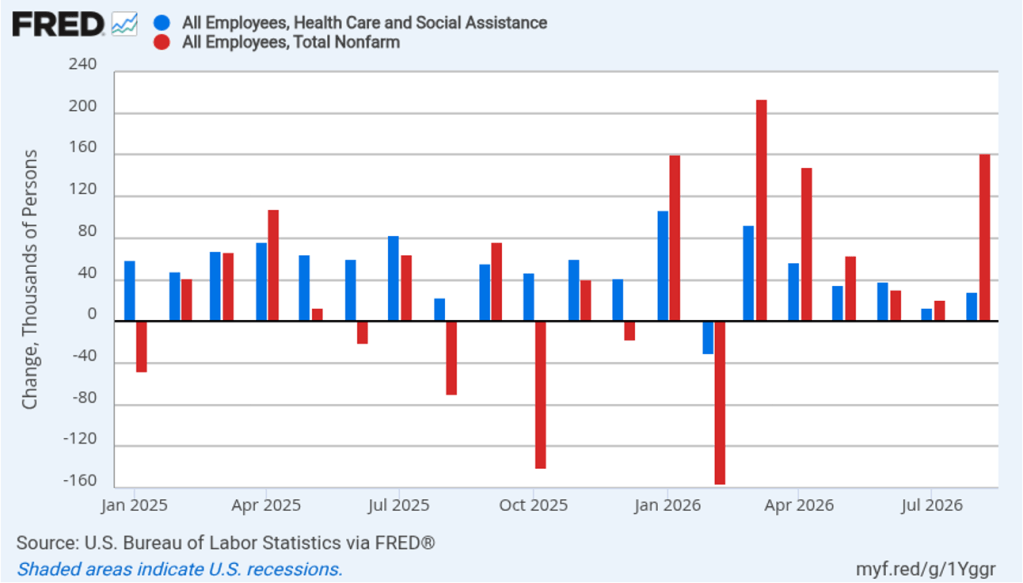

Image generated by ChatGPT
If you look again at the graph showing changes in the employment-population ratio for prime-age men (the second graph in this blog post), you’ll notice that there seems to be a ratchet effect in the data: The employment-population ratio declines during each recession (shown by the gray bars in the figure) and then struggles to return to its pre-recession level. It’s unsurprising that the male employment-population falls sharply during recessions, because, as we discuss in Macroeconomics, Chapter 13 (Economics, Chapter 23) spending on residential construction and consumer durables, such as automobiles and appliances, falls sharply during a recession.In 2025, men were 86.8 percent of workers in construction and 77.9 percent of workers in manufacturing. (In fact, as we note in that chapter, the late Edward Leamer of the University of California, Los Angeles, went so far as to argue that “housing is the business cycle.”)

Image generated by ChatGPT
Just before the Great Recession and Global Financial Crisis of 2007–2009, the prime-age male employment-population ratio was 88.0 percent, a level it hasn’t attained since. (In a recent blog post, we discuss the role the bankruptcy of the Lehman Brothers investment bank played in the financial crisis.) The prolonged unemployment experienced by some male workers in construction and manufacturing may have led to their skills deteriorating, making it more difficult for them to find employment during the following economic recovery. Some of these workers may have dropped out of the labor force resulting in a decline in the employment-population ratio.

One explanation for the declining employment-population ratio for prime-age males that has received significant attention in the media is the increased appeal of video games. Or, as the headline of an article in the New York Times put it: “Why Some Men Don’t Work: Video Games Have Gotten Really Good.” The U.S. Census Bureau annually conducts the American Time Use Survey, which is published by the BLS. The following figure shows that young adult men have increased the time they spend playing games. In 2003, men aged 21 to 30 spent an average of 2.23 hours per week. In 2025, they spent an average of 7.75 hours per week, down from a peak of 8.56 hours per week in 2022.
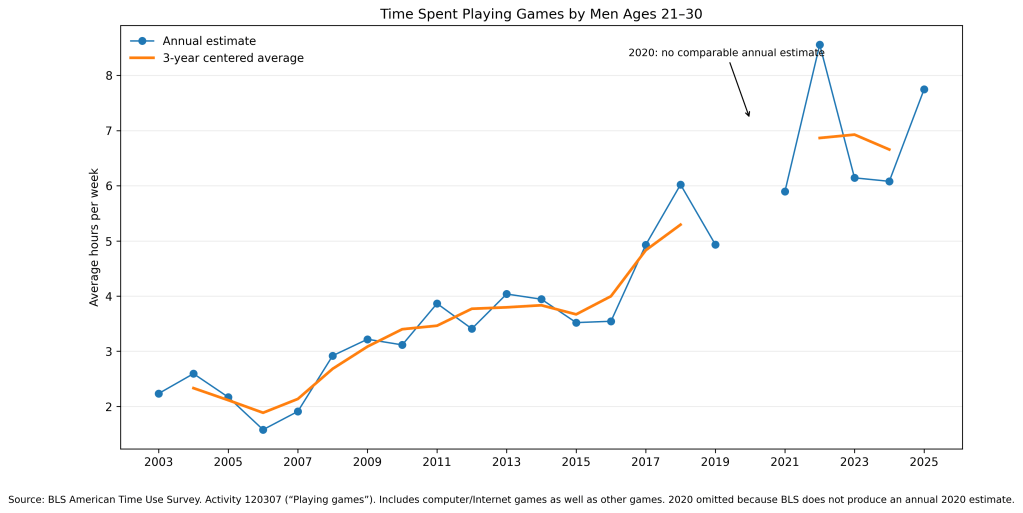
Mark Aguiar, of Princeton University, and colleagues argue that the increase in time young men devote to playing video games and engaging in other “recreational computer activities” has significantly reduced the amount of hours that some young men work. There has, however, been an academic debate over this contention. First, it’s unclear which way the causality runs: Do young men work less because they find playing video games particularly attractive or has the ability of young men to find jobs declined, so they spend time playing video games that they would rather spend working? Second, older prime-age males, who have not increased their time playing video games by as much, have also experienced a falling employment-population ratio.
There have been a number of other changes in labor markets and in American society that may have contributed to the decline in employment of prime-age males. ChatGPT offers the following summary of the various factors:
“I would rank the explanations this way:
- Most important: the disappearance of stable, comparatively well-paid routine and manual jobs available to men without college degrees, together with slow occupational and geographic adjustment.
- Closely related: educational and skills differences, the concentration of new employment in female-heavy service sectors, and the difficulty men face moving into those jobs.
- Important amplifiers: chronic health problems, mental illness, pain, opioids and other substance abuse, and the long-term effects of recessions and prolonged joblessness.
- Important for particular groups: criminal records, incarceration, geographic isolation, and weak local labor markets.
- Reinforcing social mechanisms: delayed marriage and parenthood, living with relatives, weaker social expectations concerning steady work, and reduced connection to employers and communities.
- Real but often overstated: disability benefits, other public assistance, and video games.
The central academic message is therefore different from the most sensational press version. It is not principally that millions of otherwise successful men suddenly preferred video games or welfare to jobs. The decline began with a weakening of the kinds of labor-market opportunities historically available to noncollege men. Health, addiction, criminal records, family change, geographic immobility, and more attractive leisure then made the resulting withdrawal from employment more persistent.”

