
Increased Demand for Collectibles Leads to an Increase in Supply—but Not in a Good Way

This pair of ruby slippers worn by Judy Garland playing the role of Dorothy in the Wizard of Oz sold at auction last December for $32.5 million.

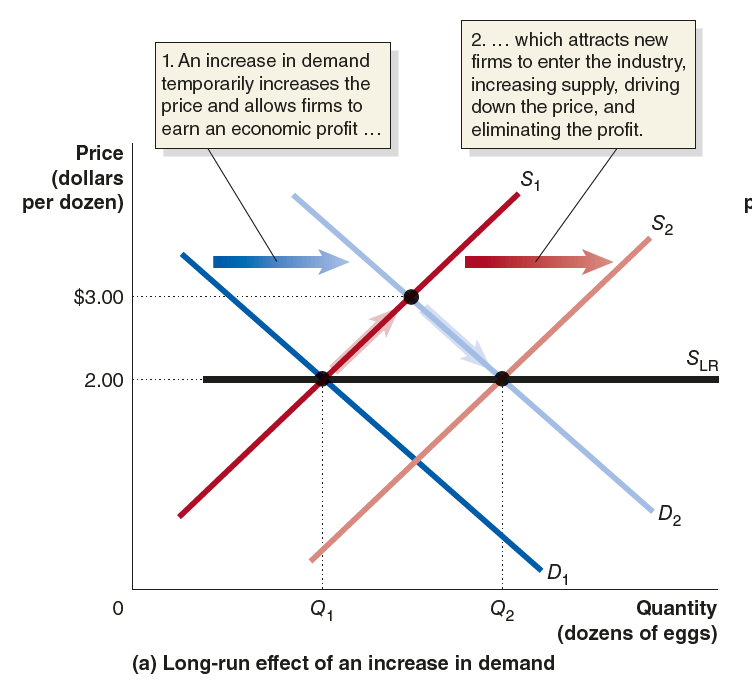
One of the most important ideas in economics is that an increase in the price of a good attracts new entrants into that market. In the short run, before there is time for new firms to enter an industry, an increase in price leads to a movement up the supply curve for the good (an increase in the quantity supplied). In the long run, a higher price leads to the entry of new firms (an increase in supply), which forces the price of the good back down to the level at which firms in the industry just break even. The following figure from Microeconomics, Chapter 12 illustrates the effects of entry in the case of the market for cage-free eggs. An increase in demand occurs when the price is $2.00 per dozen. The increased demand forces a price increase to $3.00, but, over time, entry of new firms forces the price back down to $2.00.
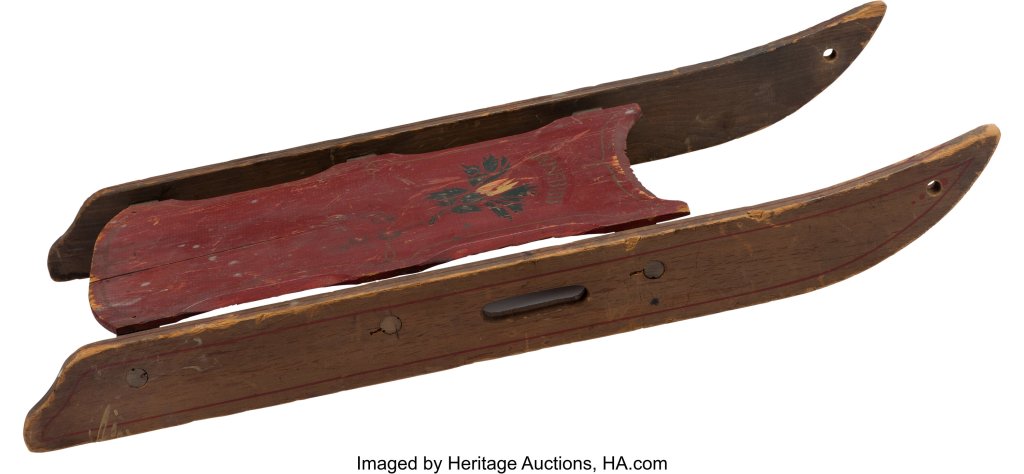
But what if the supply of a good is fixed, as in the case of collectibles such as the props used in a movie? In that situation, we would expect that entry is impossible. Demand for props used in movies—particularly classic movies—has soared in recent years leading to sharply increased prices. A pair of ruby slippers (as they are usually called even though they are actually shoes rather than slippers) used in the filming of The Wizard of Oz sold at auction in December for $32.5 million. Shown below is the “Rosebud” sled used in the filming of Citizen Kane—thought by some critics to be the greatest film ever made. It sold for $14.75 million in June of this year.
The model of an X-Wing Starfighter shown below was used in filiming the first Star Wars film and sold at auction for $3.135 million.

Unlike with cage-free eggs, these high prices won’t attract new entry because the value of these goods comes from their having been used in the making of classic films. (Of course, the high prices may lead some people who own similar props from these movies to offer them for sale—a movement up the supply curve, rather than a shift in the curve.)

According to a recent article in the Los Angeles Times (a subscription may be required), some unscrupulous people have attempted to enter the market for collectible movie props by creating counterfeits. According to the article, 3D printers have made it easier for scammers to create duplicates of movie props. For instance, according to the article, earlier this year an auction house advertised that it would be offering for sale the only surviving Han Solo DL-44 blaster used in the filming of the first Star Wars movie. (Shown in the image below, which was generated by ChatGPT.) The auction house estimated that the blaster could sell for more than $3 million.

Collectors carefully analyzed the photos shown on the auction site and discovered several discrepancies between the prop being offered for sale and the actual prop used in the film. The auction house concluded that the prop was a counterfeit and withdrew it from sale.

The article quoted Jason Henry, who is a television producer and who makes online videos on movie collectibles, as saying:

“As the prices go up, the supply is going up as well, which doesn’t seem like that’s how it should be. And it’s not because there’s actually more of the original pieces, there’s actually just more fakes or questionable pieces as we like to call it, that are flying into the market.”

It’s unfortunate, but unsurprising to an economist, that in this case the very strong incentive to enter a profitable industry has led some people to break the law by creating counterfeit movie props.

Solved Problem: Why Will No One Buy This Farm?

Supports:  Economics: Chapter 12 – Firms in Perfectly Competitive Markets (Section 12.5); Microeconomics: Chapter 12, Section 12.5; and Essentials: Chapter 9, Section 9.5

Solved Problem: Explaining Entry and Exit

An article in the Pittsburgh Post-Gazette had the headline: “The Last Harvest: Beaver County Organic Farm Closes after Failure to Find Successor.” The article discusses the decision by a 71-year old famer to close down his organic vegetable farm after failing to find a buyer for it despite a 10-year search. Several people, including his four adult children, considered purchasing the farm but in end none did so. His only requirement in selling the farm was that the buyer use the land to grow organic crops. The famer was puzzled by his inability to find a buyer because “There’s money in organics.” The article notes that: “In a U.S. Department of Agriculture study, organic food products generally commanded a [price] premium exceeding 20% over conventionally grown vegetables.”

a. Does the fact that organically grown vegetables sell for prices that are 20 percent higher than the prices of conventionally grown vegetables mean that growing organic vegetables will earn a farmer a larger economic profit than growing vegetables using conventional methods? Briefly explain.

b. Is it likely that the requirement that a buyer had to agree to use the land only to grow organic vegetables affected the inability of the farmer to find a buyer? Briefly explain.

c. What is the likeliest explanation for the farmer being unable to find a buyer for his farm?

Source: Khris B. Mamula, “The Last Harvest: Beaver County Organic Farm Closes after Failure to Find Successor,” Pittsburgh Post-Gazette, January 3, 2021.

Solving the Problem

Step 1:   Review the chapter material. This problem is about the reason that firms exit an industry, so you may want to review Chapter 12, Section 28.2 “If Everyone Can Do It, You Can’t Make Money at It.”

Step 2:   Answer part a. by discussing whether the fact that organic vegetables sell for higher prices than conventionally grown vegetables means that growing organic vegetables will earn a farmer a larger economic profit than growing vegetables using conventional methods. Profit depend on costs as well as prices. We’ve seen in this chapter that organic growing methods typically have higher costs than conventional growing methods. Therefore, the fact that organic vegetables sell for higher prices than conventionally grown vegetables doesn’t guarantee that farmers selling organic vegetables are earning an economic profit. In fact, in the long run we would expect that entry and exit will ensure that the price farmers sell vegetablesfor will just equal the average cost of growing them, whether the vegetables are grown organically or conentionally. In other words, in the long run the higher price of organic vegetables will just offset the higher cost of growthing them and farmers will earn a zero economic profit whichever method they use to grow vegetables.

Step 3:   Answer part b. by explaining whether the farme’s requirement that the farm be used only to grow organic vegetables affected his difficulty in finding a buyer. Generally when a firm exits a market, as this farmer is exiting the market for organic vegetables, the firm’s resources will be sold and used for other purposes. For example, when the market for renting videos collapsed, the buildings video rental stores had been in were used for other purposes. (A former Blockbuster video store near where one of the authors lives was converted into a tire store.) Or a resaurant serving Italian food may close and the tables, chairs, and ovens may be used by a restaurant serving Thai food that opens in the same building. By insisting that his farm only be used for growing organic vegetables, the farmer limited the number of buyers who would be interested in buying it. Anyone who wanted to use the land to grow vegetables using conventional methods or wanted to use it for a nonagricultural purpose would not buy the farm.

Step 4: Answer part c. by discussing the likeliest reason that the farmer was unable to find a buyer for his farm. We would expect that someone wanting to sell a firm that is earning an economic profit would have no trouble finding a buyer if the price being asked would allow a buyer to also earn an economic profit on the buyer’s investment. That the farmer in this article couldn’t find a buyer after 10 years of searching is an indication that a buyer of the farm at the price he was asking would at best break even. As noted in the answer to part b., that the farmer wouldn’t allow a buyer to use the land for any purpose other than organic farming reduced the number of potential buyers.