
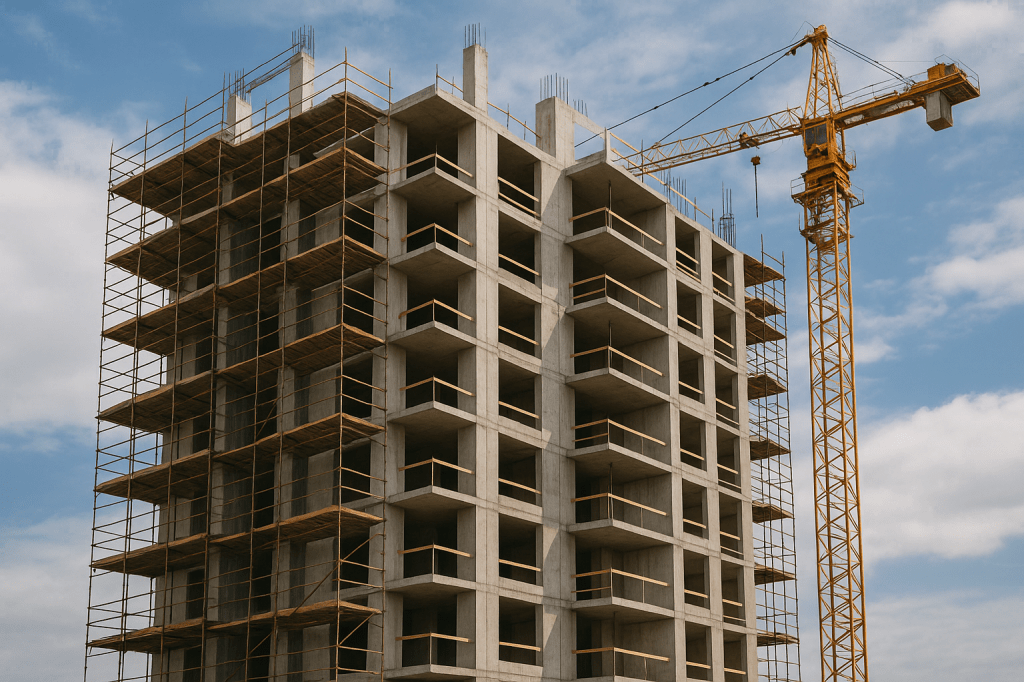
Image of an apartment house under construction generated by ChatGTP 4o.
In Chapter 1, we discuss one of our three key economic ideas: “People respond to economic incentives.” When government policymakers ignore this idea, government programs can fail to meet their goals as the following example shows.
In April 2024, to spur construction of new apartment houses, the New York state legislature enacted the Affordable Neighborhoods for New Yorkers program. The program includes what’s known as the 485-x tax break for apartment house builders. The details of the program are complex but basically a builder can have a new apartment house exempted from property taxes for up to 40 years provided that the building includes a specified number of apartments set aside for people with lower incomes. Some members of the state legislature believe that developers of larger apartment houses are typically better able to pay higher wages than are developers of smaller apartment houses. So, the legislation contained a provision that builders of projects with 100 or more units must pay construction workers at least $40 per hour.
An article in Crain’s New York Business reported today on newly released data on developers registering an interest in participating in the program. The developers proposed building 118 apartment houses. (The developers can register an interest in the program, but aren’t formally awarded the tax break until after the projects are finished.) None of the projects would have 100 or more units; three projects will have 99 units. Not too surprisingly, developers have responded to the law by building smaller apartment houses rather than larger apartment houses that would require them to pay higher construction wages. The higher wages are also required for any project built south of 96th Street in the New York City borough of Manhattan. Again, unsurprisingly, only 2 of the 118 proposed projects are located in that part of the city. Although it was not the intent of the state legislature, the law provided an economic incentive to build smaller apartment houses outside of Manhattan and builders responded to that incentive.
The article quotes the president of the Real Estate Board of New York (REBNY) as saying: “The absence of the larger projects we need at scale to meet the city’s production goals was identified early on by REBNY as a likely outcome of the new program design.”
The article is here, although a subscription may be required.
 HubbardOBrienEconomics.com Blog